Mendelssohn: Symphony No. 3 "Scottish", The Hebrides
2/20/2026, 5 Tracks, 51:15
Featuring
Alexis Kossenko
Les Ambassadeurs ~ La Grande Écurie
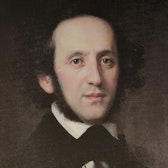
Felix Mendelssohn Bartholdy
Did you know?
1/7
Critical Reception
Mendelssohn's 'Reformation' Symphony, no. 5, was disowned by the composer not due to dissatisfaction, but because of frustration from many rejections, including one for being 'too learned and too contrapuntal'.
Compositional Technique
Mendelssohn was skilled at differentiating between liquid and solid forms in his music, using strong beats for solidity and shifting, elusive motifs for liquidity, especially in depicting ocean currents.
Interpretation
The conductor, Alexis Kossenko, uses sparing vibrato in the orchestra for both historical reasons (vibrato was a soloist's prerogative) and musical reasons, to maintain the music's forward momentum.
Composition History
Both Mendelssohn's Third Symphony and 'Hebrides' Overture have their roots in his 1829 trip to England and Scotland, which made a lasting impression on him.
Recording & Production
This album features the first-ever recording on period instruments of Mendelssohn's Third Symphony and 'Hebrides' Overture.
Composer's Artistic Vision
Mendelssohn's music, particularly in these Scottish-inspired works, often conveys a 'magical, supernatural element' and depicts landscapes with a sense of hidden, legendary creatures.
Composition History
Mendelssohn sketched the first sixteen bars of his 'Scottish' Symphony's opening movement after visiting the ruins of Mary Queen of Scots' palace in Edinburgh.
You might also enjoy...
Mendelssohn: Symphony No. 3 "Scottish" / The Hebrides
Felix Mendelssohn Bartholdy: Symphony No. 3, "Scottish" / The Hebrides, "Fingal's Cave" (Berlin Staatskapelle, Haenchen)
Mendelssohn: Symphony No. 3 in A Minor, Op. 56 "Scottish" & Die Hebriden Overture, Op. 26 (Remastered)