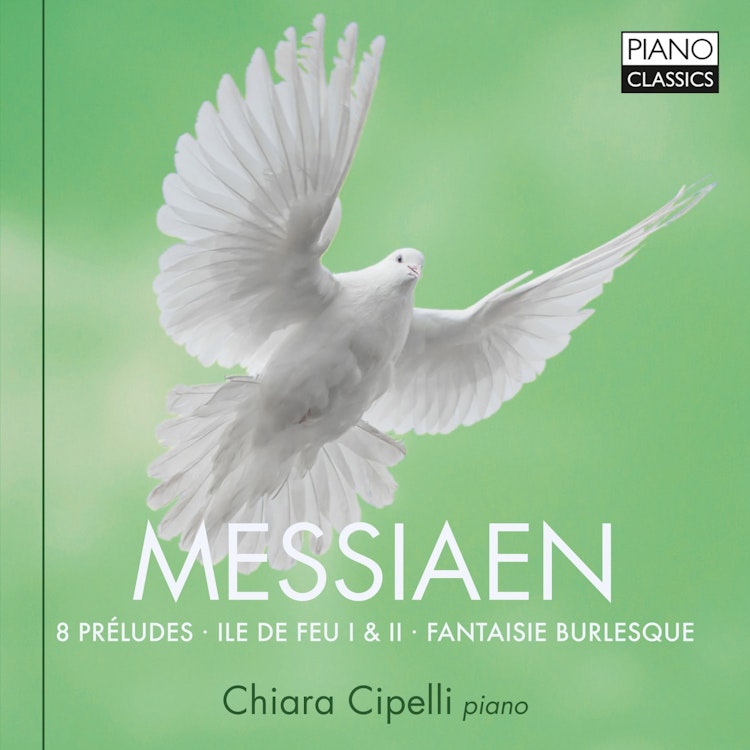
Messiaen: 8 Préludes, Ile de feu I & II, Fantasie Burlesque
1/31/2020, 13 Tracks, 59:37
Featuring
Chiara Cipelli
Olivier Messiaen
Did you know?
1/7
Composer's Artistic Vision
Messiaen perceived colors when he heard certain musical chords, a phenomenon known as synesthesia, and these color combinations were important in his compositional process.
Compositional Technique
Messiaen's music is known for its rhythmic complexity and his unique system of 'modes of limited transposition,' which are artificial scales he developed from his early compositions and improvisations.
Composition History
The pieces 'Ile de feu I' and 'Ile de feu II' are part of Messiaen's 'Quatre Etudes de Rythme' and are dedicated to the music of Papua New Guinea, with a principal motif reflecting 'the violence of the magic rites of this country.'
Composition History
Messiaen composed 'Fantaisie Burlesque' in 1932 to prove to his classmates that he wasn't always serious, though he later admitted he failed to do so.
Composer Biography
Olivier Messiaen, a major 20th-century composer, entered the Paris Conservatoire at age 11 and later taught there, with notable pupils including Pierre Boulez and Karlheinz Stockhausen.
Performer Biography
Pianist Chiara Cipelli, who performs on this album, has won numerous national and international competitions and has recorded an album dedicated to Bruno Bettinelli's piano works for Brilliants Classics.
Composer's Artistic Vision
Messiaen was fascinated by birdsong, notating bird songs from around the world and incorporating these transcriptions into his musical compositions.
You might also enjoy...
Sergei Rachmaninov: Etudes-Tableaux & Preludes (excerpts)
Kapustin: 8 Concert Etudes - 24 Preludes
Tour de Force
Fusions
Messiaen: Les Oiseaux
Virtuoso Piano Etudes, Vol. 2
Fantasia
Goldstone, A.: Tzigane (A Treasury of Gypsy Inspired Music)