The movement "Appel interstellaire" for solo horn was the first part of "Des canyons aux étoiles" to be written, originally intended as a memorial for Messiaen's pupil Jean-Pierre Guézec.
Compositional Technique
The instrumentation of "Des canyons aux étoiles" is unusual, featuring 13 individual string parts with no doubling, quadruple woodwind, triple brass, and unique percussion instruments like the éoliphone (wind machine) and géophone (sand machine).
Instruments
The géophone, a sand machine used in "Des canyons aux étoiles" to evoke the sound of the earth, was specially made to Messiaen's instructions and carefully guarded by him between performances.
Composition History
Messiaen's "Des canyons aux étoiles" was commissioned by Mrs. Alice Tully for her Musica Aeterna Orchestra to celebrate the bicentenary of the United States Declaration of Independence.
Notable Performances
The European premiere of "Des canyons aux étoiles" took place in Paris on October 29, 1975, conducted by Marius Constant, nearly a year after its New York premiere.
Composer's Artistic Vision
Messiaen conceived "Des canyons aux étoiles" as a religious work, glorifying God through the beauties of earth, the physical sky, and the spiritual sky, also incorporating geological and astronomical elements.
You might also enjoy...
Decasia
Vivaldi Sleep
Pierre Boulez: Pli selon Pli
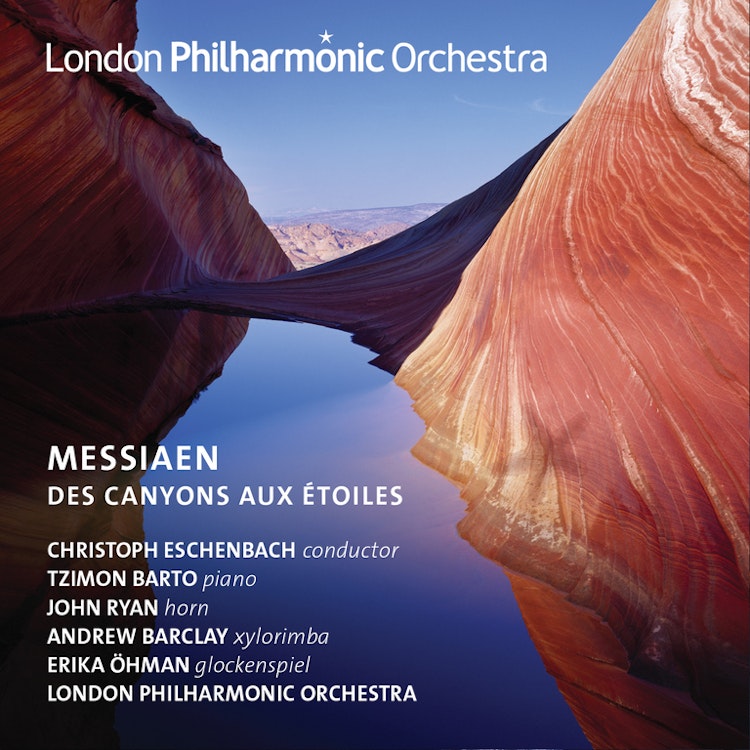
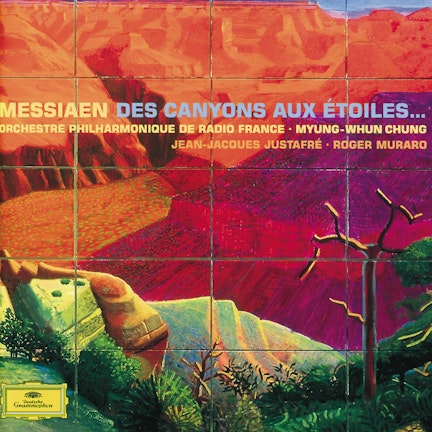
Messiaen: Des canyons aux étoiles... ("From the Canyons to the Stars...")
Boulez: Pli selon pli
Exclusive: New World Symphony and Michael Tilson Thomas - Berlioz: Harold in Italy