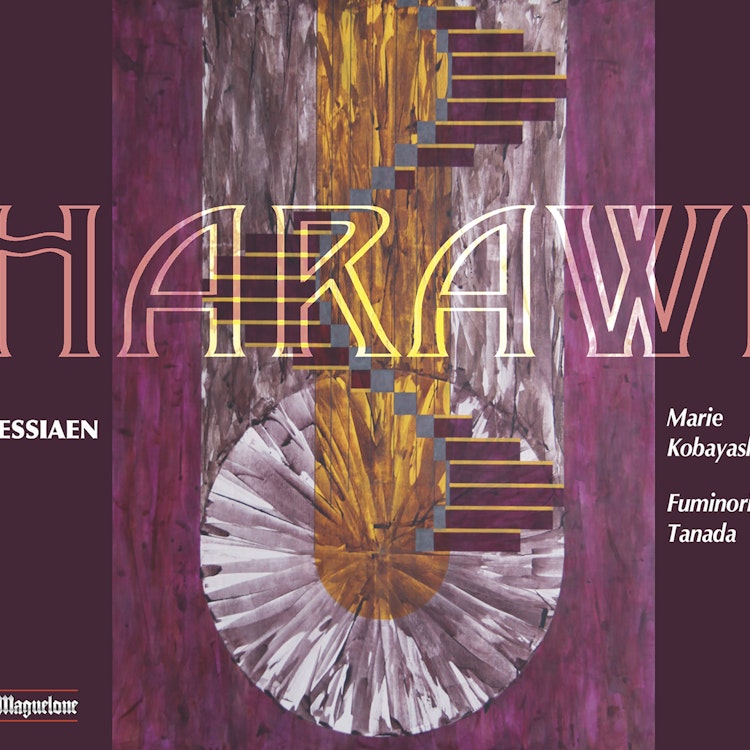
The word 'harawi' is from Quechua, the language of Peruvian Indians, and refers to a musical and poetic form, a 'song of life and death,' which Messiaen used as the cycle's subheading.
Compositional Technique
Messiaen incorporated Quechua words and phonemes into several melodies in 'Harawi,' primarily for their sound and their ability to evoke dancing.
Composition History
Messiaen composed four song cycles, including 'Harawi' from 1945, all specifically written for the dramatic soprano Marcelle Bunlet.
Performer Biography
Marie Kobayashi, the mezzo-soprano on this recording, holds a Doctor of Arts degree from the National University of Fine Arts and Music in Tokyo for her thesis on Messiaen's mélodies, specifically 'Harawi'.
Composer Biography
Olivier Messiaen's mélodies, unlike his orchestral and chamber works, are less frequently performed.
Composer's Artistic Vision
'Harawi' is the first part of Messiaen's 'Tristan Trilogy,' which also includes the 'Turangalila symphonie' and 'Cinq rechants,' offering a South-American interpretation of the Tristan and Iseult myth.
Compositional Technique
The broad vocal range required in Messiaen's mélodies makes them challenging to perform.
You might also enjoy...
Richard Strauss: Lieder
Connection: Three Song Cycles of Jake Heggie
The Art Of Irmgard Seefried – Volume 8: Wolf & Strauss Lieder
Little Cakewalk
Respighi: Deità silvane
Nuit d'Étoiles: The Forgotten Songs of Charles-Marie Widor