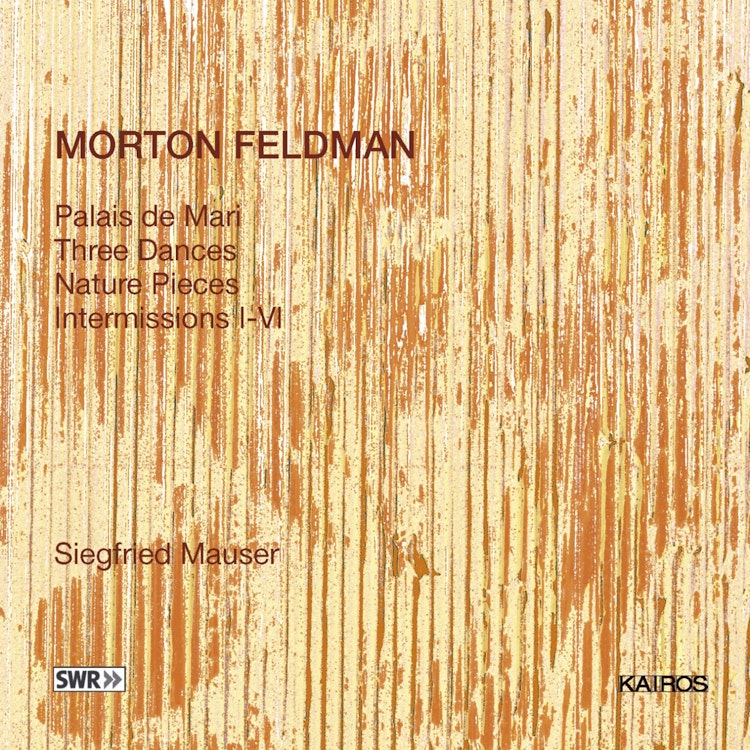
Siegfried Mauser, the pianist on this recording, is a professor at the 'Mozarteum' Salzburg and the Academy of Music and Theater Munich, where he also served as rector.
Composition History
The pieces 'Three Dances' are previously unpublished works, found as manuscripts in the Paul Sacher Foundation, and are recorded for the first time on this CD.
Recording & Production
This album intentionally contrasts Feldman's early works with his last piano piece, Palais de Mari, to document his evolutionary cycle as a composer.
Interpretation
Contrary to a long-held belief that Feldman's music should be played emotionlessly, the composer himself emphasized clarity of periodic structures, subtle phrasing gestures, and a richly differentiated sound, even referencing Schubert and Debussy.
Composer Biography
Morton Feldman's musical aesthetics were profoundly influenced by his circle of friends in New York, which included painters like Philip Guston and Mark Rothko, and musicians such as John Cage and David Tudor.
Composer's Artistic Vision
Feldman's piano works, from beginning to end, are central to understanding the unique characteristics of his aesthetic.
Compositional Technique
Feldman's 'Intermissions I-VI' feature experimental aspects like using mute keys for indirect resonance and a formal-aleatoric arrangement of sounds, which can even be played by two pianists on two pianos.
You might also enjoy...
Silvestrov: ...Flowering Over Lethe...
Restart
Silvestrov: Echoes of Harmony
Silvestrov: Piano Music
Abendland - Erstes Stundenbuch
Epitaphs & Portraits
Koechlin: Heures Persanes (Les)
Hindemith: In einer Nacht, Op. 15: No. 2, Sehr langsam