Wolfgang Amadeus Mozart wrote "occasional music" (non-concert music) consistently throughout his life, including works for recreation, formal balls, and various social events.
Composition History
Mozart's Serenade in E flat major, K. 375, was originally composed for six instruments and premiered on St. Theresa's Day in 1781, with musicians surprising Mozart by playing it under his window.
Performer Biography
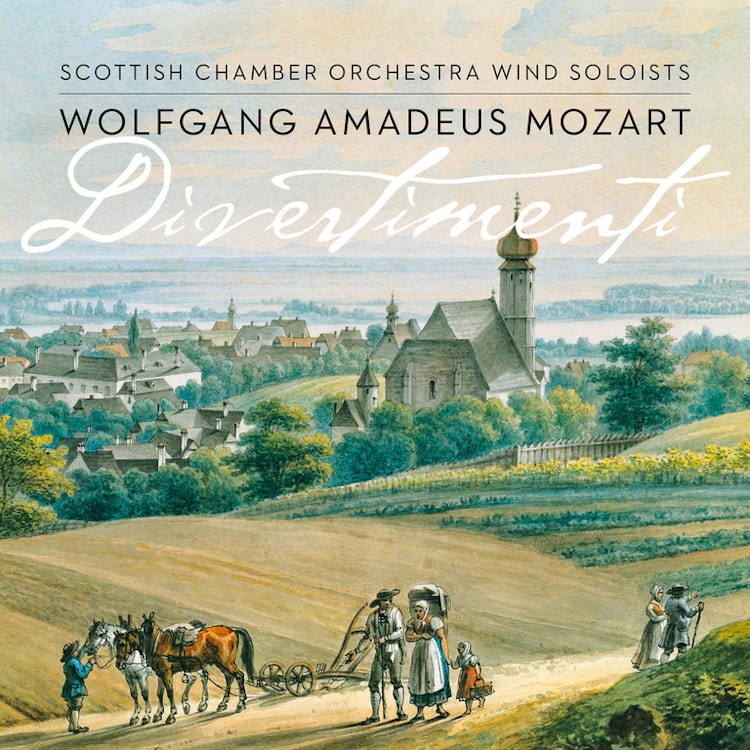
The Scottish Chamber Orchestra Wind Soloists, featured on this album, began exploring Harmoniemusik repertoire in 2012, inspired by the legacy of great Mozartian conductors like Sir Charles Mackerras.
Recording & Production
This recording features four of Mozart's five Tafelmusik sextets for pairs of clarinets, horns, and bassoons, along with the Serenade in E flat major, K. 375.
Compositional Technique
Mozart's occasional music often expands on the four-movement symphonic structure, frequently including a march, additional slow movements, or a theme with variations.
Composer's Artistic Vision
Despite being conceived for casual entertainment rather than concerts, Mozart's occasional music demonstrates his genius in overcoming potential limitations with lightness of material and absence of overt theatricality.
Historical Context
In Mozart's time, "Harmoniemusik" specifically denoted a wind octet of two oboes, two clarinets, two horns, and two bassoons, a term that later became general for any wind ensemble.
You might also enjoy...
Mozart: Partitas for Winds
Die Zauberflöte
Mozart: Piano Trio, K. 498, 'Kegelstatt' / Violin Sonata No. 26 (Arr. for Clarinet and String Trio)
Basset Horn Divertimenti
Serenades & Divertimenti
Mozart: Wind Music, Vol. 3
Mozart: Music for Wind Instruments
Mozart: Cosi fan tutte, K. 588 & Die Entführung aus dem Serail, K. 384
Mozart: Serenades Nos. 11 & 12
Mozart: Serenade in B-Flat Major "Gran Partita", KV 361 & Serenade in E-Flat Major, KV 375