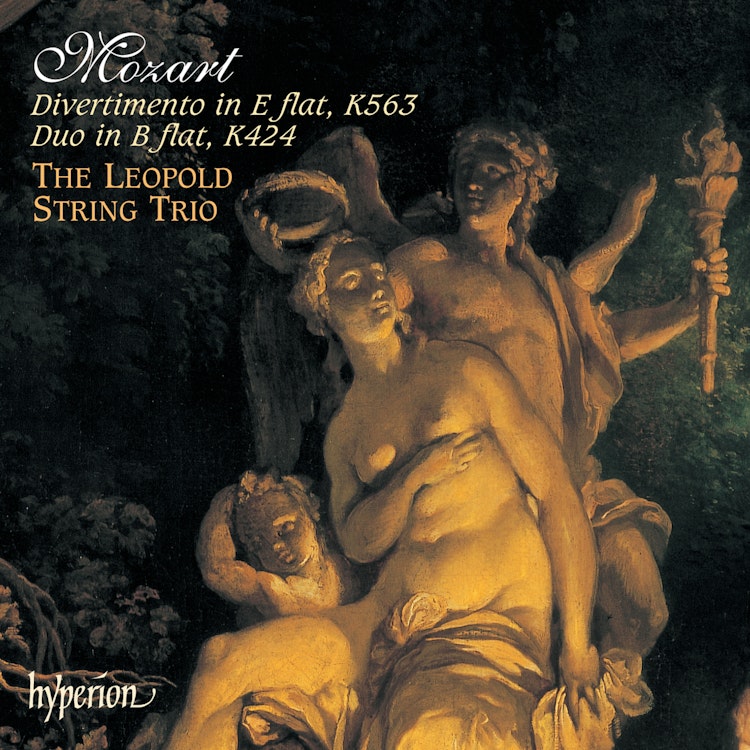
Mozart: Divertimento for String Trio; Duo for Violin & Viola No. 2
1/26/2024, 9 Tracks, 1:07:35
Featuring
Marianne Thorsen
Scott Dickinson
Kate Gould
Leopold String Trio
Wolfgang Amadeus Mozart
Did you know?
1/7
Composition History
The Divertimento K563 was almost certainly composed for Mozart's friend and fellow-mason, Michael Puchberg, who was a wealthy businessman and later financially assisted Mozart's widow, Constanze.
Compositional Technique
In his duos, Mozart treated the viola more equally with the violin, demanding elaborate contrapuntal exchanges, complicated double stopping, and an extended range of nearly three octaves from the instrument.
Compositional Technique
In the Divertimento K563, Mozart adopted the light divertimento style as a starting point but introduced unexpected procedures and surprises in each movement, enriching and deepening the music.
Composer's Artistic Vision
Mozart, like Joseph Haydn, demonstrated that music as entertainment could also contain original, enlightening, and profound ideas.
Composer Biography
Mozart married Constanze Weber in August 1782 against his father's wishes, leading to a strained family relationship.
Composer Biography
The period leading up to the composition of the Divertimento K563 in 1788 was marked by deep financial crisis for Mozart, yet it was also highly productive, seeing the completion of his last three symphonies, two piano trios, and the 'easy' Piano Sonata K545.
Composition History
Mozart's two duos (K423 and K424) were likely composed to help Michael Haydn, Joseph Haydn's younger brother and a composer employed in Salzburg, complete a set of six duos requested by the Archbishop.
You might also enjoy...
Discovering the Classical String Trio, Vol. 4
Luigi Boccherini: Die Streichtrios, Op. 47, No. 1-6