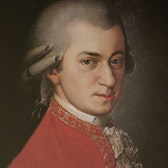
Mozart in Milan: Sacred Music around the Exsultate, jubilate
1/20/2023, 25 Tracks, 1:16:49
Featuring
Giulio Prandi
Robin Johannsen
Carlo Vistoli
Raffaele Giordani
Alessandro Ravasio
Maria Cecilia Farina
Renato Cadel
Ghislieri Consort
Ghislieri Choir
Schola Gregoriana Ghislieri
Johann Christian Bach
Wolfgang Amadeus Mozart
Giovanni Andrea Fioroni
Melchiorre Chiesa
Anonymous
Did you know?
1/7
Composition History
Mozart's sacred masterpiece, Exsultate, jubilate, was composed for the castrato soprano Venanzio Rauzzini, the leading man in Mozart's opera Lucio Silla, and performed in Milan in 1773.
Historical Context
In 1770, Charles Burney and a young Wolfgang Amadé Mozart both noted Milan's vibrant musical culture, especially the free church performances that shaped public taste.
Composer Biography
Johann Christian Bach, son of J.S. Bach, moved from Germany to Milan in 1755, converted to Catholicism, and became second organist of the Milan cathedral in 1760.
Performer Biography
Robin Johannsen, an American soprano, is known for her affinity for Baroque and Classical repertoires and frequently performs with René Jacobs and the Freiburger Barockorchester.
Performer Biography
Giulio Prandi, the conductor, is a mathematician, artistic director, and founder of the Coro e Orchestra Ghislieri, known for rediscovering 18th-century Italian vocal music.
Compositional Technique
The Milanese churches offered a unique blend of plainchant, 18th-century Renaissance counterpoint, and the modern galant style, further enriched by the city's 'bi-ritualism' of Ambrosian and Roman rites.
Compositional Technique
Mozart's Misericordias Domini, a model of modern polyphony, features a motif that coincidentally anticipates the opening bars of Beethoven's Ode to Joy by half a century.
You might also enjoy...
Sacred Songs
Sacred Songs
A Christmas Celebration
Choral Concert: Americas Vocal Ensemble - Guastavino, C. / Rausch, C. / Davila, A.P. / Chazarreta, A. / Walsh, M.E. / Lifchitz, M. / Granda, C.