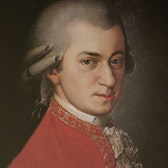
This recording uses the 18th-century Prelleur temperament, which makes the Fantasy's D major section sound purer and gentler, and dramatic passages more intense, compared to modern equal temperament.
Composer's Artistic Vision
Mozart's works for clarinet, especially those written for virtuoso Anton Stadler, helped elevate the instrument from its orchestral role to a solo star.
Composition History
The Kegelstatt Trio, K. 498, was written for Mozart's friends: clarinetist Anton Stadler, talented student Franziska von Jacquin (for piano), and Mozart himself (for viola).
Historical Context
Eighteenth-century Vienna was a vibrant musical center with many professional musicians, publishers, instrument builders, and talented female keyboard players who cultivated salons.
Composer Biography
Mozart moved to Vienna in 1781 to pursue a freelance career, believing it to be "the best place in the world" for his profession.
Instruments
Mozart's Clarinet Quintet and Concerto were originally written for the basset clarinet, an instrument with an extended lower range, developed by Anton Stadler and Theodor Lotz.
Historical Context
Musical arrangements were crucial in the 18th century, allowing music lovers to play popular works like Mozart's Figaro at home before recordings existed.
Piano Recital: Laun, Susan Von - Haydn, F.J. / Bach, J.C. / Mozart, W.A. / Schubert, F. / Chopin, F.
Beethoven, L.: Piano Quintet in E-Flat Major / Mozart, W.A.: Piano Quintet in E-Flat Major
Mozart - Beethoven: Piano Quintets
Mozart: Quintet in E-flat Major for Piano & Winds, K. 452; Beethoven: Quintet in E-flat Major for Piano & Winds, Op. 16 [Rudolf Serkin - The Art of Interpretrat
Vladimir Selivokhin. Piano Music
Bach, J.C.: 6 Keyboard Concertos, Op. 7
Kraus: Complete Piano Music
Live at the Concertgebouw
Four Square
The Unreleased Recordings (Decca Masters and Radio Tapes 1970-2002)
Piano Recital: Pasini, Marco - Hummel, J.N. / Moscheles, I. / Kuhlau, F. / Liszt, F. / Busoni, F. / Dallapiccola, L. (A Tribute To Paganini)