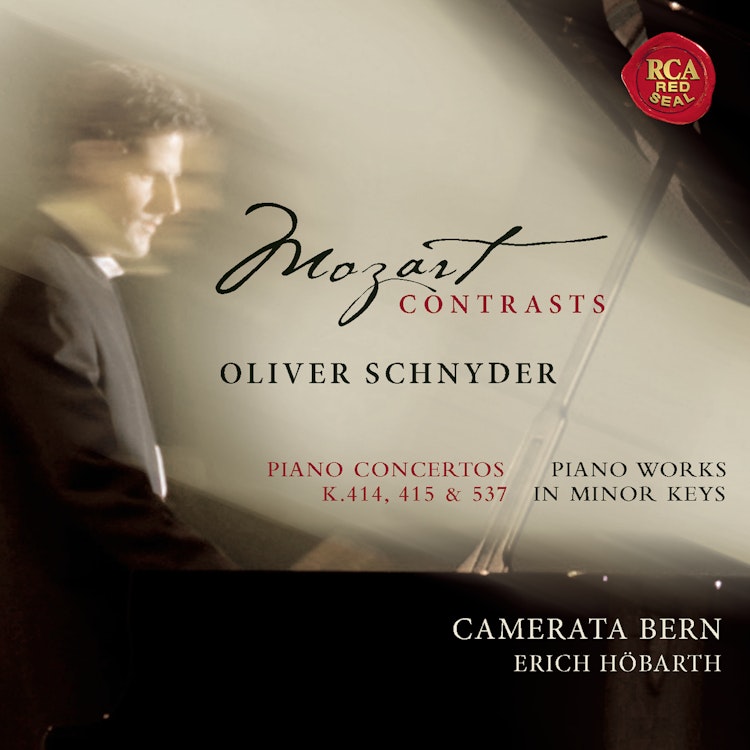
Mozart: Piano Concertos 12, 13, 26 + Works In Minor For Solo Piano
12/18/2008, 19 Tracks, 2:27:26
Featuring
Oliver Schnyder
Camerata Bern
Wolfgang Amadeus Mozart
Did you know?
1/7
Compositional Technique
Mozart's minor-key works often convey emotions like fear, wrath, and melancholy, contrasting with the light-heartedness, love, and gentleness typically expressed in major keys.
Composition History
Mozart's A minor Rondo K.511 was composed in 1787 following the death of his friend Count von Hatzfeld, and the B minor Adagio K.540, with its 'danse macabre' rhythm, was written almost exactly a year later.
Composition History
Mozart's Sonata K.310 in A minor is often linked to the death of his mother in Paris in 1778, with a legend claiming he worked on its finale while her body lay nearby.
Composer's Artistic Vision
Mozart described his piano concertos K. 413, 414, and 415 as a "happy medium between too heavy and too light," brilliant, pleasant, and natural, satisfying both connoisseurs and general listeners.
Historical Context
In the Haydn-Mozart era, major keys predominated significantly, with 89-95% of symphonies, string quartets, and piano sonatas by both composers written in major.
Compositional Technique
For his piano concertos, Mozart often allowed for an alternative scoring where the wind section could be omitted, and the solo piano accompanied by strings alone, to increase performance and sales opportunities.
Composer's Artistic Vision
Mozart's keyboard fantasias, like those by Carl Philipp Emanuel Bach, are considered 'composed improvisations' that directly translate the composer's own feelings, showcasing a subjective approach to music.
You might also enjoy...
Mozart: Piano Concertos Nos. 12, 13, 26 & Works for Solo Piano
Mozart: Piano Concertos 12, 13, 26 + Works In Minor For Solo Piano
Reflections On Mozart
Weihnachten in alten und modernen Gedichten & Geschichten
Mozart: Solo Piano Works
Mozart Recital
Mordecai Shehori Plays Mozart, Vol. 1
Mozart Matures
The Secret Mozart
Piano Sonata No. 12 in F Major, K.332/300k: II. Adagio