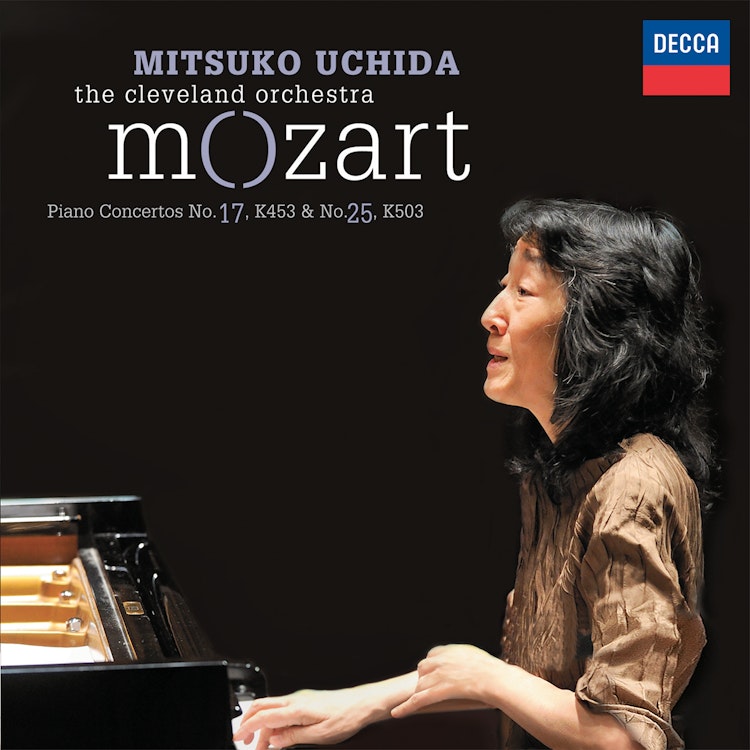
Mozart: Piano Concertos No.17, K.453 & No.25, K.503
10/28/2016, 6 Tracks, 1:07:21
Featuring
Mitsuko Uchida
The Cleveland Orchestra
Wolfgang Amadeus Mozart
Did you know?
1/7
Compositional Technique
Uniquely in Mozart's concertos, a march theme in K503 returns prematurely to form the entire basis of the development section, featuring a complex triple canon.
Compositional Technique
The C major Concerto K503 begins imperiously with trumpets and drums, but its confident surface is soon ruffled by the shadow of the minor key.
Cultural Impact
Beethoven was so impressed by Mozart's use of 'interrupted' cadences in K453 that he borrowed the technique for his Violin Concerto and Triple Concerto.
Compositional Technique
In the opening movement of K453, Mozart uses 'interrupted' cadences to broaden the music's tonal horizons and create dramatic changes in direction.
Composition History
Mozart composed the Piano Concerto No. 17 in G major, K453, and the Piano Concerto No. 25 in C major, K503, for his subscription concerts in Vienna.
Composer Biography
Mozart bought a pet starling that could whistle the 'chirping' theme of the K453 finale, noting the purchase in his expenses book.
Composition History
The Piano Concerto No. 17, K453, was written for Mozart's piano pupil Barbara ('Babette') von Ployer, who performed it on June 13, 1784.
You might also enjoy...
Mozart: Piano Concertos Nos. 21 & 27
Mozart: Piano Concerto No. 21 In C major K.467
Mozart: Piano Concertos Nos. 26-27
Mozart: Piano Concerto No. 17 in G Major, K. 453
Mozart: Clavier-Concerte 24 & 25
Mozart: Piano Concertos Nos. 21 & 24
Mozart: Piano Concertos Nos. 18 & 19
Mozart: Piano Concertos Nos. 18 & 19
Mozart: Piano Concertos Nos. 20 & 27
W.A. Mozart: Piano Concertos No. 21 in C Major, K. 467; Piano Concerto No. 27 in B-Flat Major, K. 595