Mozart designed these concertos to appeal to a broad audience, being 'midway between too difficult and too easy,' satisfying both connoisseurs and non-connoisseurs.
Compositional Technique
The opening of the Andante of the A major concerto quotes an overture by Johann Christian Bach, a tribute to an old friend with whom Mozart improvised piano duets as a child.
Composition History
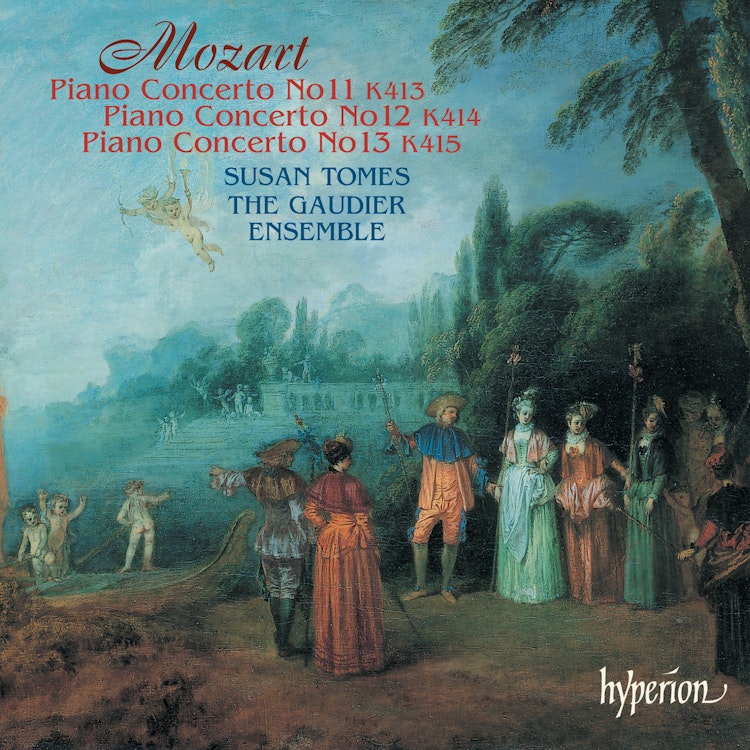
These three piano concertos (K413-415) were the first in a series of great concertos Mozart wrote for Vienna and the first to be published in a printed edition.
Historical Context
By the early 1780s, the piano was replacing the harpsichord as the most favored keyboard instrument across Europe, a change in which Mozart played a significant role.
Interpretation
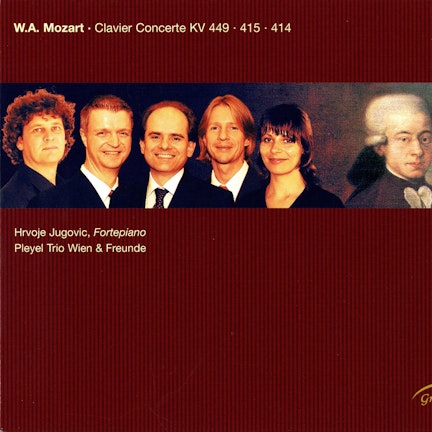
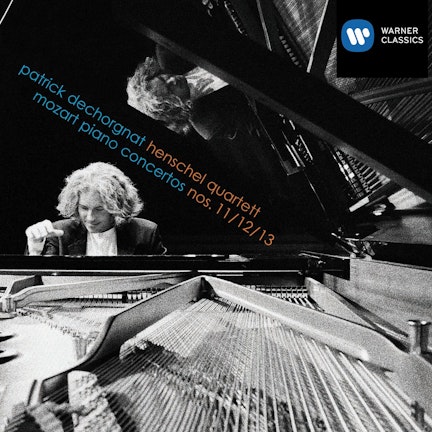
Playing these concertos in chamber form, as in this recording with a string quartet and double bass, offers advantages in transparency and rhythmic buoyancy, allowing for immediate interaction between musicians.
Instruments
Mozart was particularly impressed by the fortepianos of Johann Andreas Stein, a piano-maker in Augsburg, admiring their even tone, efficient dampers, and escapement mechanism.
Composer Biography
After settling in Vienna in 1781, Mozart, having broken free from his post with the Archbishop of Salzburg, worked to establish himself as a mature composer and keyboard virtuoso.
You might also enjoy...
Mozart: Piano Concertos Nos. 12-14
Mozart: Piano Concertos Nos. 12 & 13
Mozart: Piano Concertos, Vol. 3
Mozart: Piano Concertos K. 413, K. 414 & K. 415
Haydn: Three Piano Concertos
Mozart: Piano Concertos Nos 11-13
Mozart: Piano Concertos Nos. 17 and 18
Mozart: Clavier-Concerte 18 & 19
Mozart: Concerto No. 7 in F Major, K. 242 "Lodron" for Three Pianos and Orchestra: III. Rondeau
Mozart: Piano Concertos Nos. 12 & 13 (Arr. I. Lachner)
Haydn: Piano Concerto, Hob.XVIII:3
Haydn: Klavierkonzerte
Mozart: Piano Concertos Nos. 12, 13 & 14, The Chamber Version