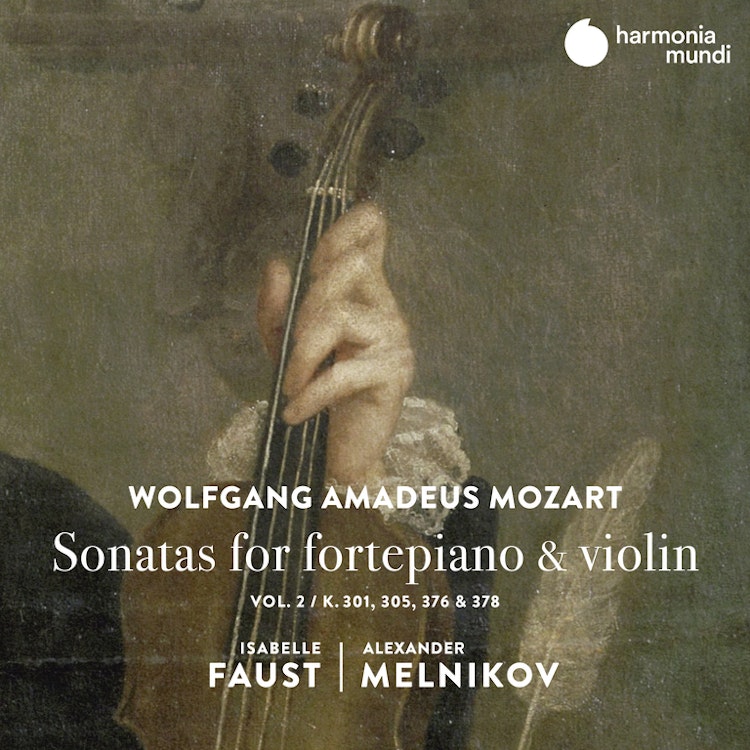
Leading instrumentalists Isabelle Faust and Alexander Melnikov play a second selection of Mozart's Sonatas for Fortepiano and Violin – primarily conceived as keyboard sonatas with violin accompaniment, rather than the other way around. Faust and Melnikov both play period instruments.
Featuring
Alexander Melnikov
Isabelle Faust
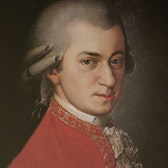
Wolfgang Amadeus Mozart
Did you know?
1/7
Composition History
Early sonatas for keyboard and violin, including Mozart's first sixteen, often treated the violin part as optional ('ad libitum') and limited to doubling the keyboard.
Compositional Technique
In these sonatas, Mozart moved away from the two-movement form popular in Mannheim and Paris, adopting the Italian three-movement structure used by Schuster to amplify drama and contrasts.
Instruments
Isabelle Faust performs on an A. Stradivarius 'Sleeping Beauty' violin from 1704, loaned by the L-Bank Baden-Württemberg.
Instruments
Mozart was impressed by the fortepianos of Johann Andreas Stein, which featured an 'escapement action' that prevented notes from clattering or continuing to sound after being struck.
Composition History
Joseph Schuster, Kapellmeister to the Elector of Saxony, pioneered a new balance between keyboard and violin in sonatas, which Mozart admired and emulated.
Composition History
The six Palatine Sonatas (K301-306) were begun in Mannheim and completed in Paris, and are dedicated to the wife of Prince-Elector Karl Theodor.
Composer Biography
At 21, Mozart was dismissed from his position by Archbishop Colloredo in Salzburg, leading him to travel Europe and take on material responsibilities for the first time.
You might also enjoy...
Mozart: Sonatas for Violin & Piano, K. 301, K. 304, K. 305 & K. 454