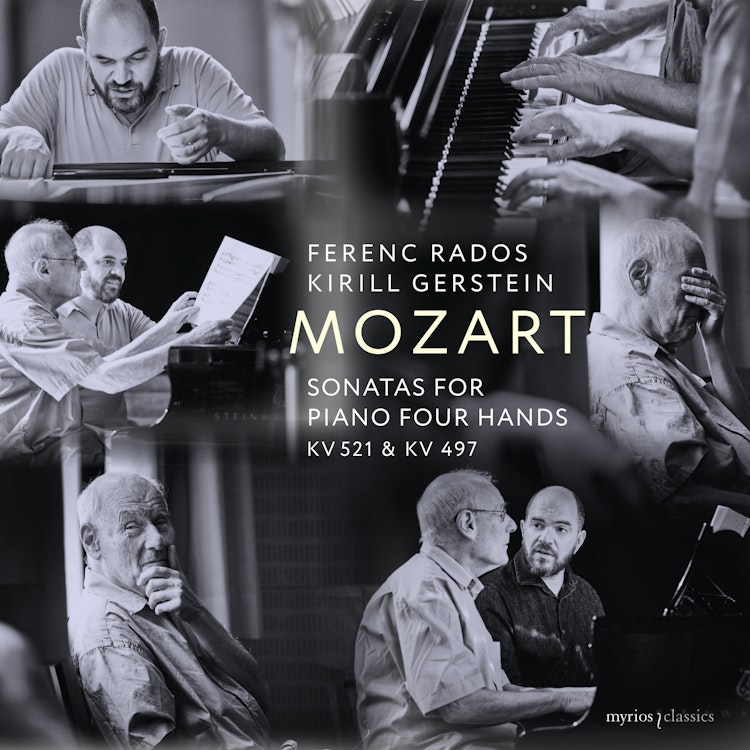
Mozart: Sonatas for Piano Four Hands, K. 521 & 497
5/21/2021, 6 Tracks, 1:05:00
Gramophone Editor's Choice
Featuring
Ferenc Rados
Kirill Gerstein
Wolfgang Amadeus Mozart
Did you know?
1/7
Performer Biography
Ferenc Rados, born in Budapest in 1934, is a singular personality and mentor to many prominent Hungarian musicians, including pianists Zoltán Kocsis, Deszö Ránki, and András Schiff.
Compositional Technique
Mozart revolutionized the piano duet genre, particularly with the F major Sonata on this album, elevating it beyond typical 'Hausmusik' (domestic music-making) to a symphonic scope and complexity.
Compositional Technique
Ferenc Rados believes that 17th and 18th-century music is more 'neurotic' and 'nervous' than Romantic music, characterized by shorter, more declamatory phrases or conjoined smaller elements.
Performer Biography
Kirill Gerstein considers Ferenc Rados the single most influential person in his musical life, having studied with him the longest after previous studies in Russia, Boston, New York City, and Madrid.
Interpretation
Ferenc Rados's approach to interpretation is based on foundational elements of musical substance, such as structural and metric stresses, harmonic relationships, and motivic declamations, rather than stylistic fashions.
Interpretation
Kirill Gerstein's experience with jazz and improvisation influenced the spontaneously added ornaments in the C major Sonata, where he played the primo (top part).
Interpretation
The piano duet genre requires an exceptional degree of mutual intimacy and a 'togetherness of attitude,' making it a unique and challenging form of chamber music.
You might also enjoy...
Mozart: Sonatas for Piano 4 Hands, K. 357, 358, 381 & 497
Mozart: Piano Sonatas with Varied Reprises, K. 279–284
Mozart: Sonatas for Two Pianos and Piano Four-Hands
Mozart: Piano Sonatas Nos. 12 & 17
Mozart: Piano Sonata, K. 331 "Alla turca"
The Koroliov Series, Vol. 18
Mozart: Sonatas for Piano 4 Hands, K. 381, 497 & 521 and 5 Variations in G Major for Piano 4 Hands, K. 501
Piano Sonatas Nos. 1-6
Mozart: Piano Sonatas, Vol. 1 (Piano Sonatas Nos. 8, 10 and 15)
Mozart: Piano Sonata No. 3 in B-flat Major, K.281. II. Andante amoroso
Mozart: Piano Sonatas
Mozart: Piano Sonata No. 6 in D Major, K. 284 "Dürnitz"