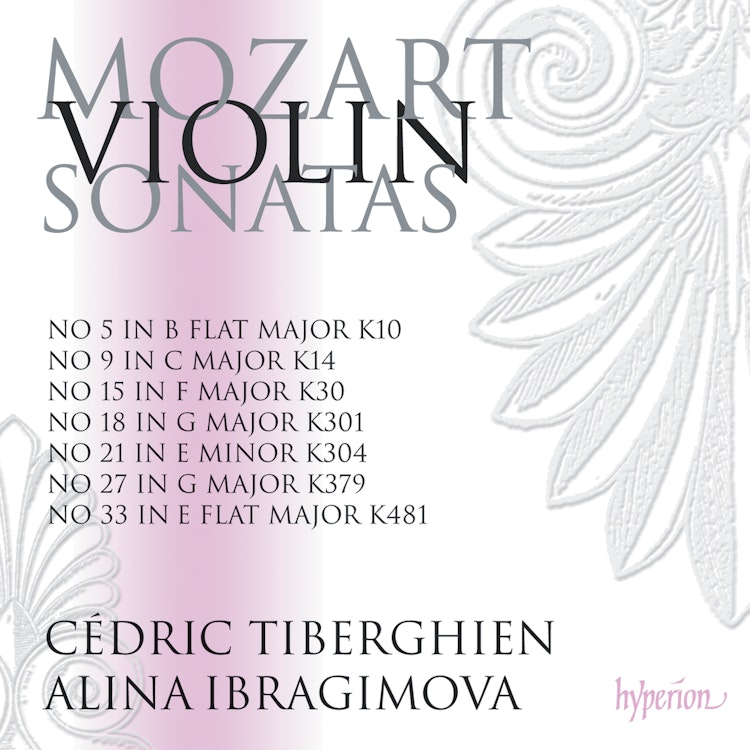
The Sonata in G major, K301, was originally intended for a Dutch amateur flautist named Ferdinand Dejean, but Mozart adapted it for violin, utilizing the instrument's wider range.
Compositional Technique
Mozart's early sonatas for keyboard and violin grew out of a popular form where non-keyboard instruments had no independent melodic material, allowing the music to be played as a solo sonata if needed.
Historical Context
The early sonatas, K10-15, were dedicated to Queen Charlotte, wife of George III, and Mozart likely played them for the royal couple at Buckingham House.
Compositional Technique
The Sonata in E flat major, K481, features remarkable enharmonic key changes in its slow movement, moving rapidly between 'flat' and 'sharp' regions, with instruments briefly notated in different key signatures simultaneously.
Performer Biography
Alina Ibragimova, the violinist on this recording, performs on an Anselmo Bellosio violin from around 1775, provided by Georg von Opel.
Composition History
Mozart's earliest published compositions, Sonatas K6-9, were released when he was just seven years old, with the title page proudly announcing his age.
Composition History
The Sonata in G major, K379, was composed so quickly—Mozart claimed in a single hour—that he had to play the piano part from memory at its premiere.
You might also enjoy...
Mozart: Sonatas "Opus II" for Pianoforte and Violin