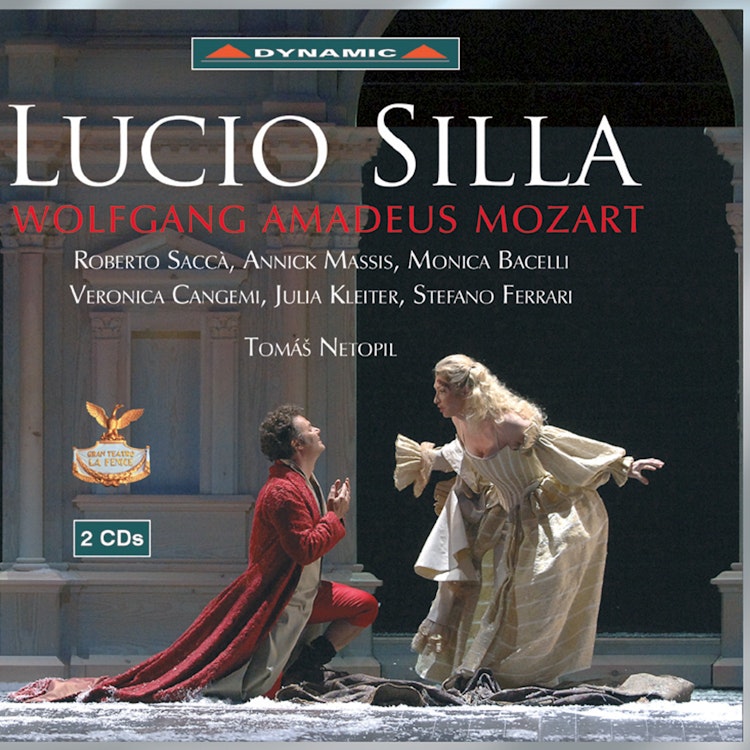
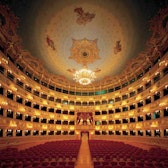
Mozart, W.A.: Lucio Silla (Teatro La Fenice, 2006)
7/1/2007, 43 Tracks, 2:23:43
Featuring
Roberto Saccà
Annick Massis
Monica Bacelli
Verónica Cangemi
Julia Kleiter
Stefano Ferrari
Tomáš Netopil
Teatro la Fenice Orchestra
Teatro la Fenice Chorus
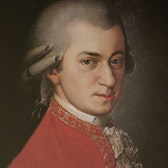
Wolfgang Amadeus Mozart
Did you know?
1/7
Compositional Technique
In "Lucio Silla," Mozart moved beyond traditional Neapolitan opera structures by using numerous accompanied recitatives, choruses, and arias that did not always follow the 'da capo' form, alongside bold harmonic and melodic features.
Composition History
Mozart had very little time to compose "Lucio Silla," as it was intended to open the carnival season on December 26, 1772, and most of the work, including the main roles, still needed to be written.
Cultural Impact
Although "Lucio Silla" did not lead to concrete career opportunities in Italy, Mozart gained significant 'artistic' profit from the experiments introduced in this opera, which he later applied to other works.
Composition History
Mozart, at sixteen, was commissioned to compose "Lucio Silla" for the Regio Ducal Theatre in Milan after the success of his previous operas, "Ascanio in Alba" and "Mitridate, re di Ponto."
Critical Reception
Despite a clumsy replacement singer and a rather arid libretto, the premiere of "Lucio Silla" was very positive, leading to over twenty performances, which was unusual for Milanese theatres at the time.
Composer's Artistic Vision
Mozart's use of various solo aria forms and the abandonment of the single 'da capo' model in "Lucio Silla" demonstrate his desire to find the most suitable structure for expressing different emotional states.
Composition History
The tenor originally cast as Lucio Silla, Cardoni, fell seriously ill, forcing Mozart to find a last-minute replacement, Bassano Morgnoni, a 'church cantor from Lodi,' who only joined rehearsals on December 17.
You might also enjoy...
Mozart: Die Zauberflöte
Mozart: Così fan tutte (Highlights - Sung in Italian)