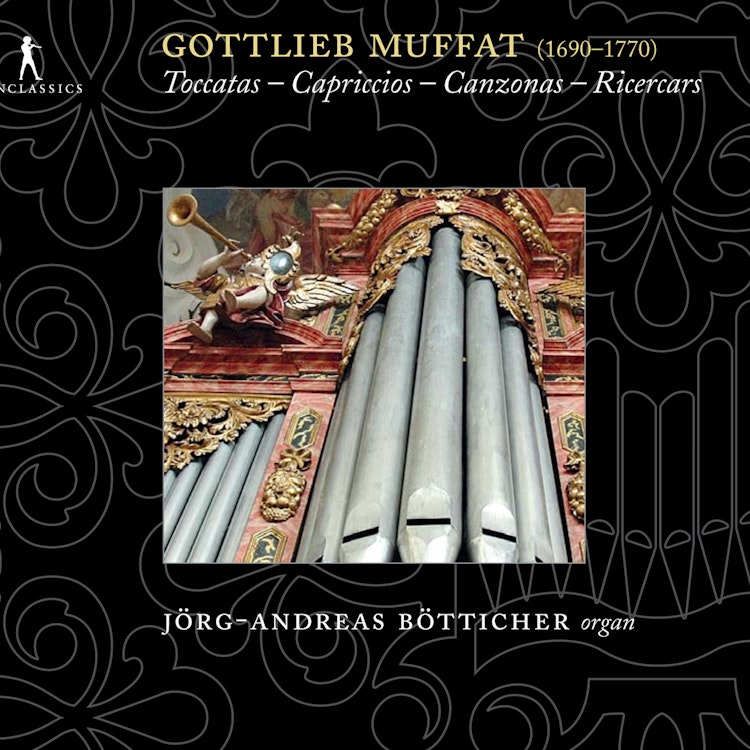
Muffat often paired his toccatas with a Capriccio, an idea that can be traced back to him, refining the traditional burlesque-inspired concept of the genre.
Composer Biography
Gottlieb Muffat was appointed official court and chamber organist in Vienna in 1717, and also served as organist to the dowager empress Wilhelmine Amalie.
Instruments
Three organs from the Monastery of Muri are used in this recording, including a large organ built by Thomas Schott (1619-1630) and two choir organs built by Joseph and Viktor Ferdinand Bossard in 1743.
Composer Biography
Gottlieb Muffat, son of Georg Muffat, was christened on April 25, 1690, and grew up in a musical environment focused on compositional traditions and contrapuntal rules.
Compositional Technique
Muffat's toccatas follow the South German-Italian model, characterized by small playing figures and transitional sections of varying intensity, rather than independent parts.
Historical Context
The organs of the monastery church of Muri, where this recording was made, are among the best-preserved Baroque organs in Switzerland and reflect a flourishing musical practice of the Benedictine monastery during the 17th and 18th centuries.
Composition History
Muffat's most significant organ works remained unpublished during his lifetime; their dissemination was largely due to the Viennese Minorite father Alexander Giessel, who transcribed many of them.
You might also enjoy...
Breaking Ground
Scheidemann: Organ Works, Vol. 1
Balbi: Psalmi ad Vesperas Canendi per Annum, Vol. 1
Reincken - Kneller - Geist: Complete Organ Works
Leyding, Kneller & Geist: Complete Organ Music
Bossi: Opera omnia per organo, Vol. 5
Saxer, Duben, Schiefferdecker: Complete Organ Works
Französische Orgelmusik (Movimentos Edition)
Women of History
The Art of the Ricercar in 16th Century Italy
Lubeck, V.: Organ Music (Norddeutsche Orgelmeister, Vol. 1)
Andreas Willscher: Organ Works
Zardini: Organ Works, Messa in simplicitate & Minuetto per orchestra