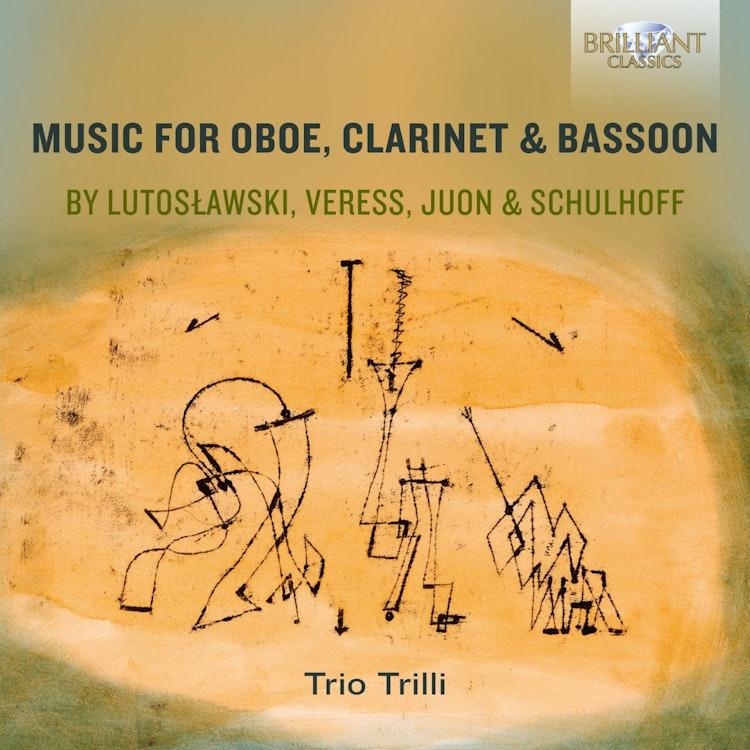
Music for Oboe, Clarinet & Bassoon by Lutoslawski, Veress, Juon & Schulhoff
1/31/2020, 17 Tracks, 55:48
Featuring
Massimiliano Salmi
Paolo Beltramini
Diego Chenna
Trio Trilli
Witold Lutosławski
Sándor Veress
Paul Juon
Erwin Schulhoff
Did you know?
1/7
Composer's Artistic Vision
A common thread among the diverse musical styles of the four composers on this album is the incorporation of elements from the folkloric and popular traditions of Eastern European music.
Composition History
Witold Lutosławski's Trio for Oboe, Clarinet and Bassoon was composed in an attic in Komorów in 1944-45, after he and his mother fled Warsaw following the Warsaw Rising.
Compositional Technique
The reed trio, consisting of oboe, clarinet, and bassoon, offers composers a rich palette for fascinating sonorities due to the instruments' similar yet subtly different sounds.
Composer Biography
Three of the four composers featured on this album — Paul Juon, Sándor Veress, and Erwin Schulhoff — were citizens of the Austro-Hungarian Empire before its dissolution.
Historical Context
Despite their presence in many chamber and symphonic works, the oboe, clarinet, and bassoon only regularly appeared as a dedicated chamber ensemble, the reed trio, in the twentieth century.
Compositional Technique
Lutosławski's Trio was an experimental work where he explored new compositional techniques, focusing on wind instruments to research pitch, rhythm, and sound organization for his First Symphony.
Historical Context
The lives and posthumous reputations of several composers on this album, including Erwin Schulhoff who died in a concentration camp, were significantly impacted by the tragic political events of the twentieth century.
You might also enjoy...
Arenzana, M.: Maitines Para La Virgen De Guadalupe / Te Deum (Baroque Mexico, Vol. 8)
Guiding Light
Love I Obey
Il diavolo nel cervello - Devil in The Brain (Original Motion Picture Soundtrack)
Rondo alla Turca
The Leap
Brendon Randall-Myers: Dynamics of Vanishing Bodies