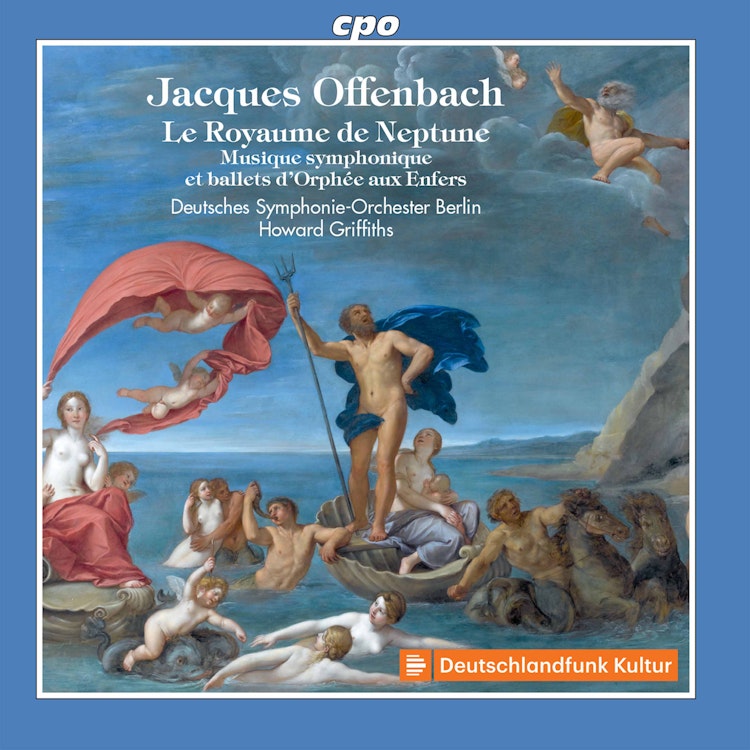
Musique symphonique et ballets d'Orphée aux enfers
11/1/2019, 24 Tracks, 1:09:53
Featuring
Howard Griffiths
Deutsches Symphonie-Orchester Berlin
Jacques Offenbach
Carl Binder
Did you know?
1/7
Cultural Impact
Offenbach's "Orphée aux Enfers" became his first worldwide success, establishing a new genre called the "Offenbachiade," which was a form of social satire in musical theater.
Composition History
In 1874, Offenbach thoroughly revised "Orphée aux Enfers," transforming it from a two-act "opéra-bouffon" into a four-act "opéra-bouffe-féerie" with lavish staging and new musical numbers.
Notable Performances
After its premiere, "Orphée aux Enfers" was performed almost continuously in Paris, reaching its 1000th performance by 1878.
Recording & Production
The ballet "L'Atlantide" from "Orphée aux Enfers" was rediscovered by Jean-Christophe Keck in an old storage box and is receiving its recording premiere on this CD.
Composition History
Carl Binder (1816-1860), a conductor at Vienna's Carl-Theater, created the popular "Binder Overture" for "Orphée aux Enfers" because the original 1858 version lacked a substantial overture.
Compositional Technique
Offenbach frequently reused his own music, borrowing from his "Décaméron dramatique" for the "Pastoral Ballet" in "Orphée aux Enfers" and later reusing music from "L'Atlantide" in "Le Voyage dans la lune."
Composition History
Jacques Offenbach's "Orphée aux Enfers" (Orpheus in the Underworld) marked the beginning of operetta history, building on his earlier one-act productions and the works of his colleague Hervé.
You might also enjoy...
Offenbach - Le Romantique
Wagner: Orchestral Music
Marschner: Overtures & Stage Music, Vol. 1
Schreker: Orchestral Music from the Operas
Auber: Overtures, Vol. 4
Wagner: Orchestral Highlights
Wagner: Orchestral Highlights
Wagner, S.: Complete Overtures, Vol. 2
Zemlinsky: Lyric Symphony etc
Zemlinsky: Lyrische Symphonie, Op. 18 & Orchestral Preludes and Interludes
Zemlinsky: Der Zwerg & Opern-Vorspiele & -Zwischenspiele