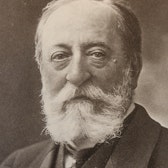
Most works on this album come from the first half of Saint-Saëns's composing life, when he was often ahead of his audience.
Performer Biography
Neeme Järvi, the conductor on this album, has amassed a distinguished discography of more than 440 discs, with over 150 of them for Chandos.
Critical Reception
Saint-Saëns's symphonic poem Danse macabre caused widespread consternation at its premiere due to its use of a deformed 'Dies irae' plainsong, a screeching solo violin, and a xylophone.
Composer Biography
Saint-Saëns enjoyed traveling and found Algiers to be a favorite haven for the rest of his life, where he also eventually died.
Composer Biography
Camille Saint-Saëns (1835-1921) was sometimes seen as a "sunken vessel" by musicologists, partly due to his outspoken criticism of early 20th-century "new" music.
Notable Performances
Saint-Saëns's opera Samson et Dalila owed its 1877 premiere to Franz Liszt, who staged it in Weimar, before the Paris Opéra finally performed it in 1892.
Compositional Technique
Saint-Saëns's symphonic poem Phaëton uses a large orchestra, including contrabassoon, tuba, two harps, and three drummers playing chords on four timpani, an idea borrowed from Berlioz.
You might also enjoy...
Glazunov: Orchestral Works, Vol. 1
Smetana, B.: Orchestral Works, Vol. 1 - Richard Iii / Wallenstein's Camp / Hakon Jarl / The Prague Carnival