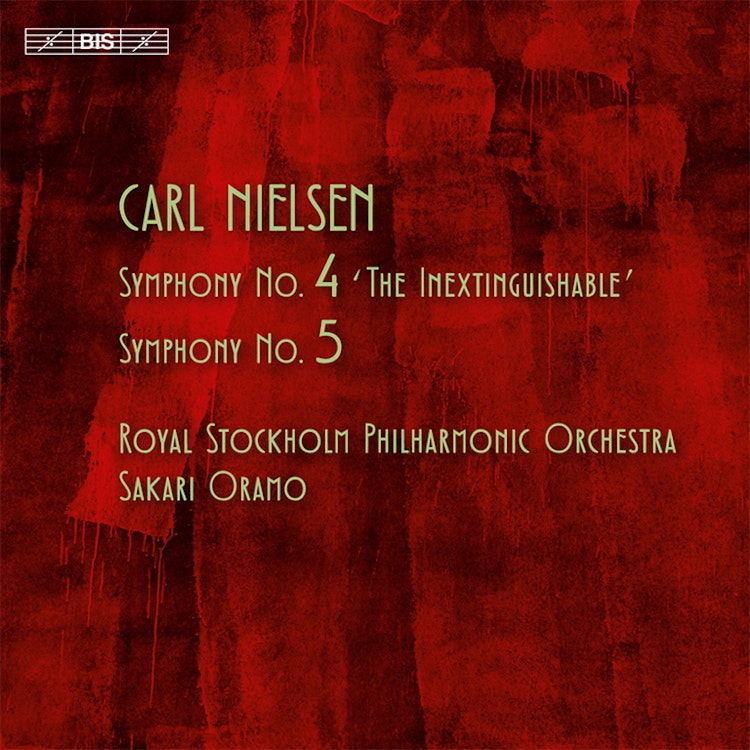
Nielsen intended 'The Inextinguishable' to express the 'Elemental Will of Life', believing that music, like life itself, is inextinguishable.
Critical Reception
Despite its initial reception, Nielsen's Symphony No. 5 achieved posthumous international recognition, notably at the 1950 Edinburgh Festival, and is now considered a 20th-century masterpiece.
Compositional Technique
The Symphony No. 4 features two spatially separated sets of timpani that battle with the rest of the orchestra.
Critical Reception
Nielsen's Symphony No. 5 initially faced strong negative reactions, with some critics calling it 'dirty trenches-music' and audiences walking out.
Composer Biography
Carl Nielsen and Jean Sibelius, though born in the same year, pursued independent paths in Nordic symphonism.
Performer Biography
Sakari Oramo, the conductor on this album, began his musical career as a violinist and was leader of the Finnish Radio Symphony Orchestra.
Composition History
Nielsen's Symphony No. 4, 'The Inextinguishable', was composed during a period of personal turmoil and global war, causing him to re-examine his values.
You might also enjoy...
Tchaikovsky: Symphony No. 6 in B Minor, Op. 74 "Pathétique"
Rubinstein: Symphony No. 4, 'Dramatic'
Ultimate Classics - Berlioz: Fantasy Symphony
Berlioz: Symphonie fantastique
Rachmaninoff: Symphony No. 3 in A Minor, Op. 44
Rachmaninoff: Symphony No. 2 in E Minor, Op. 27
Nielsen: Symphonies Nos. 3 & 4
Tchaikovsky: Symphony No. 6 in B Minor, Op. 74 "Pathétiqe"
Gade, N.: Symphonies Nos. 4 and 6
Rachmaninoff: Symphony No. 2 in E Minor, Op. 27
Nielsen: Symphony No. 2, Op. 16 "The Four Temperaments"