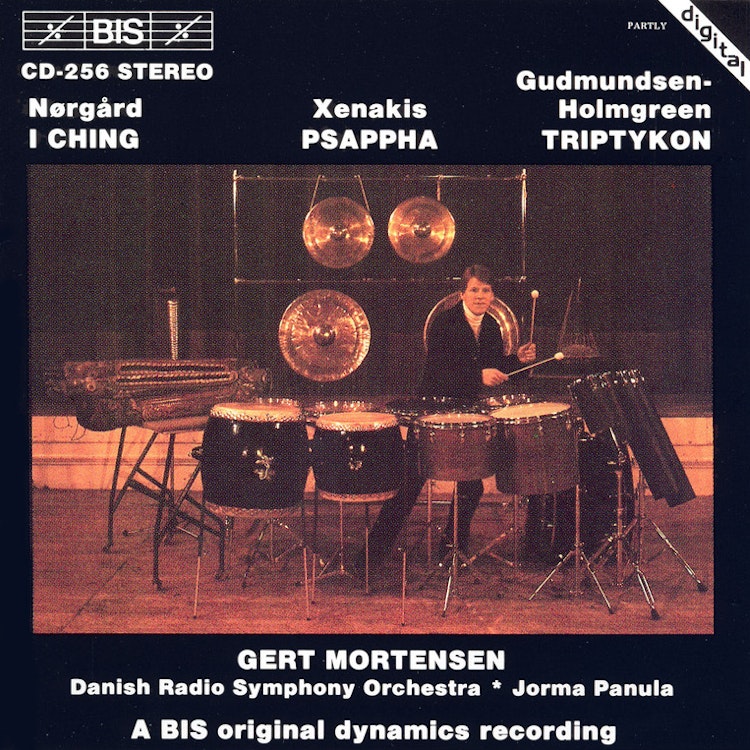
Norgard: I Ching / Xenakis: Psappha / Gudmundsen-Holmgreen: Triptykon
1/31/1989, 8 Tracks, 1:10:03
Featuring
Gert Mortensen
Jorma Panula
DR SymfoniOrkestret
Per Nørgård
Iannis Xenakis
Pelle Gudmundsen-Holmgreen
Did you know?
1/7
Composer's Artistic Vision
Since about 1960, Per Nørgård has used "infinite structures" as a basic method of composition, drawing inspiration from the light and dark lines of yin and yang in the ancient Chinese book I Ching.
Composition History
Per Nørgård's "I Ching" was written at the request of Gert Mortensen, the percussionist on this album, and was exclusively performed by him until 1985.
Compositional Technique
In Xenakis's "Psappha", timbre and pitch are subordinate to and serve only to clarify the rhythm, which is highly complex with variations and combinations of rhythmical cells.
Performer Biography
Gert Mortensen, the percussionist, studied Gamelan music on Bali with composer Per Nørgård and brought back numerous instruments not typically found in Western European percussion.
Composition History
Pelle Gudmundsen-Holmgreen's "Triptykon" was composed in close collaboration with the soloist Gert Mortensen, the percussionist on this album.
Composer Biography
Iannis Xenakis, a Greek-French composer, worked concurrently as a composer and an architect in Le Corbusier's office during the early years of his career.
Performer Biography
Gert Mortensen, the percussionist on this album, is considered one of Denmark's leading percussionists and has won several prestigious awards, including the Jacob Gade prize and the Carl Nielsen prize.