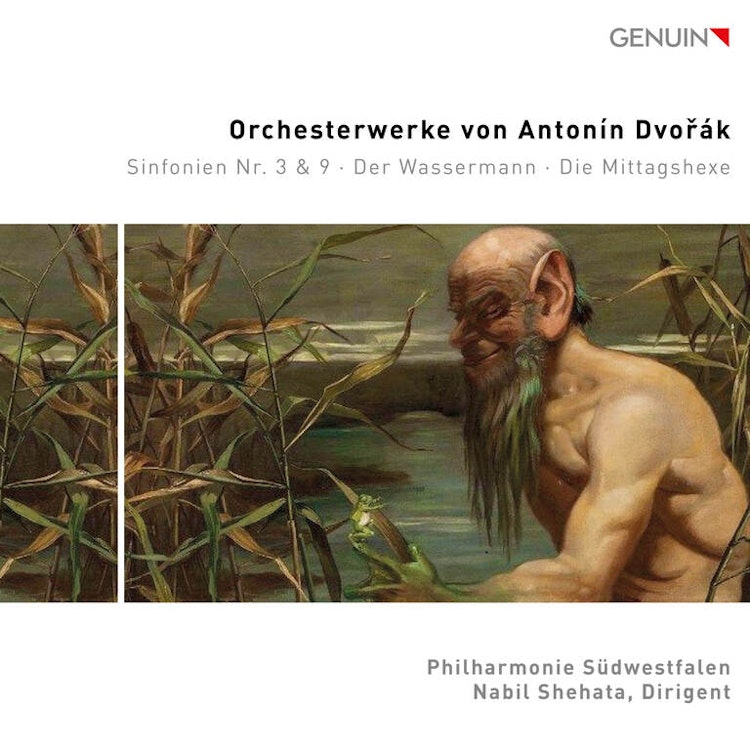
Antonín Dvořák, one of the most well-loved composers in the Western world, returned to his Bohemian homeland in the mid-1890s after a three-year stay in America.
Performer Biography
Nabil Shehata, the conductor on this album, began his career as principal bass player with the Staatskapelle Berlin and the Berlin Philharmonic before pursuing conducting.
Composer's Artistic Vision
Dvořák's symphonic poems weave the speech rhythm and characteristic style of their original poetic models into the musical fabric, making the language of the poetry a template for the works' main themes.
Recording & Production
This album was recorded at Stadthalle Betzdorf, Germany, between May 18-20, 2021, with Phillip Schulz as the Recording Producer/Tonmeister and Editor.
Composition History
In 1896, Dvořák composed a cycle of symphonic poems, including The Wild Dove, The Water Goblin, The Golden Spinning Wheel, and The Noon Witch, based on ballads by Karel Jaromír Erben.
Compositional Technique
Dvořák's symphonic poems of 1896, such as The Noon Witch and The Water Goblin, are notable for their clear musical structure and directly recognizable extra-musical programs.
Composer's Artistic Vision
Dvořák's 'American style,' developed during his time in America, incorporated influences from the culture and music of indigenous peoples, which he found fascinating.
You might also enjoy...
Dvorak: Symphony No. 6 / The Water Goblin
Dvorák: Symphony No. 6 / Janácek: Taras Bulba
Dvořák: Complete Symphonies, Vol. 1
Dvořák: Symphony No. 5 F major Op. 76 / symphonic poem, Op. 110
Antonín Dvořák: Symphony No. 6 in D major, Op. 60 & Vodnik op. 107 / The Water Goblin
Dvorak: Symphony No. 7 - The Golden Spinning Wheel
Dvorak: Symphony No. 5 / The Water Goblin
Dvořák: Symphony No. 9 "From the New World" & A Hero's Song, Op. 111
Dvorák : Symphony No.7 & The Wild Dove
Dvorak: Symphony No. 6 / The Wild Dove
Dvorak: New World Symphony - Tchaikovsky: Romeo and Juliet
Scriabin: Symphony No. 2 / Symphonic Poem in D Minor