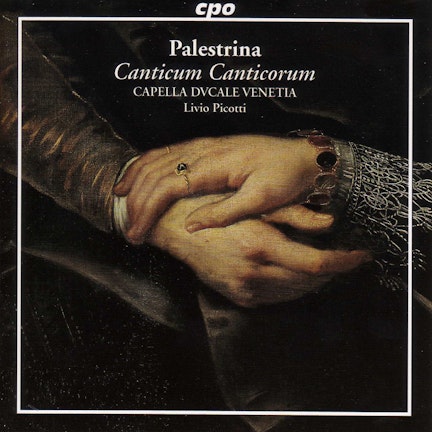
Giovanni Pierluigi da Palestrina, the composer, published his settings of the Song of Songs in 1584, dedicating the volume to Pope Gregory XIII.
Historical Context
The Song of Songs, despite its sensual text, was interpreted by Palestrina and others as an allegory for 'the divine love of Christ and his spouse, the soul,' fitting into Counter-Reformation religious art aesthetics.
Compositional Technique
This collection is unique in Palestrina's career as he set the Song of Songs as a unified cycle, rather than a compilation of separately composed works, and maintained the original biblical order.
Compositional Technique
Musically, the collection is divided into four parts, exploring different modal areas available to 16th-century composers, with these tonal areas coinciding with the text's subdivisions.
Interpretation
This recording presents Palestrina's motets as a continuous reading of the Song of Songs, reflecting the composer's apparent intention for them to be performed as a unified narrative.
Composer's Artistic Vision
Palestrina described the musical style of these motets as 'a little more lively' than his usual sacred compositions, attributing this to the sensual nature of the Song of Songs texts.
Compositional Technique
Palestrina used more word painting in these motets than in most of his sacred music, musically depicting imagery like 'rise' with upward motions or 'I went down' with descending melodic lines.
You might also enjoy...
Tallis / Byrd: Cantiones Sacrae 1575
Gesualdo: Sacrae Cantiones
Rore: Sacred & Secular Motets
Taverner: Missa Corona Spinea; Votive Antiphon: O Wilhelme Pastor Bone
Byrd: Tribue, Domine: I. Tribue Domine
De Wert: Motets, Book I (1566)
Lejeune: Dix Pseaumes de David
Victoria: Requiem Mass
Codex Speciálník
Missa Christe Jesu: III. Sanctus
Palestrina: Motets, Book 4, "Canticum Cantocorum" (Song of Songs) (1584)