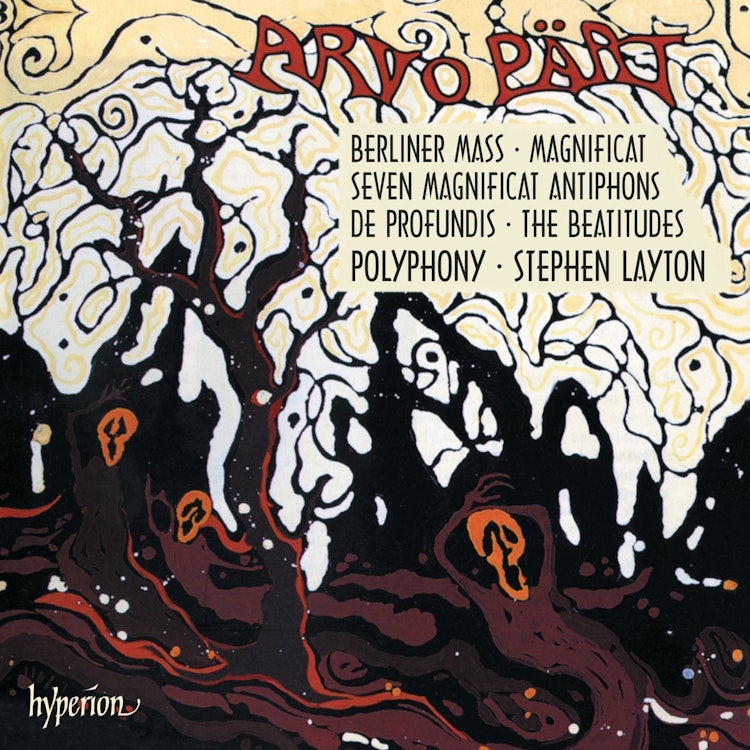
Pärt: Berliner Messe; Magnificat; Annum per Annum; 7 Antiphons
7/28/2023, 25 Tracks, 1:13:38
Featuring
Stephen Layton
Andrew Lucas
Polyphony
Arvo Pärt
Did you know?
1/7
Composer's Artistic Vision
Arvo Pärt's 'tintinnabulation' style, which he describes as working with very few elements like a single note or triad, is a central aspect of his music.
Critical Reception
Arvo Pärt is broadly known as a 'mystic minimalist,' a description he shares with composers John Tavener and Henryk Górecki.
Composer Biography
Despite a popular narrative of an eight-year silence, Arvo Pärt composed his major work, the Third Symphony, in 1971 during this period, hinting at his later style.
Performer Biography
Polyphony, the choir on this recording, was formed by Stephen Layton in 1986 and has performed and recorded internationally to critical acclaim.
Composition History
The Credo from Pärt's Berliner Messe is a reincarnation of his earlier work Summa, but in a major key, celebrating greater freedoms in post-Communist Europe.
Composer Biography
Arvo Pärt, an Estonian composer, was initially known as an 'enfant terrible' who produced his country's first 12-tone score in 1960.
Compositional Technique
Pärt's 'tintinnabulist' works achieve eloquence through simplicity, often using the diatonic scale, arpeggios, and resourceful manipulations of the triad.