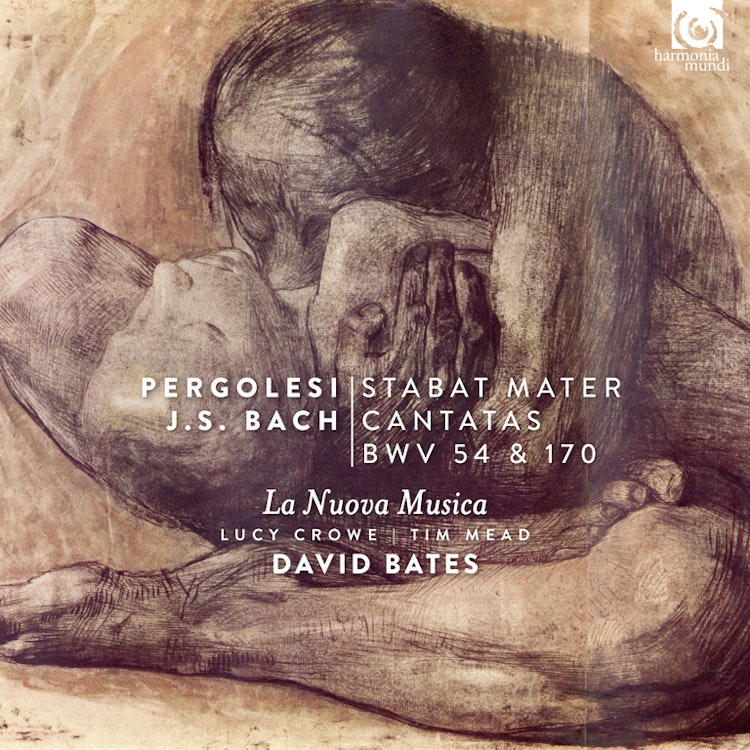
Pergolesi: Stabat Mater - Bach: Cantatas BWV 54 & 170
3/24/2017, 20 Tracks, 1:04:13
Featuring
David Bates
Mhairi Lawson
Tim Mead
Lucy Crowe
La Nuova Musica
Johann Sebastian Bach
Giovanni Battista Pergolesi
Did you know?
1/7
Composition History
Pergolesi's Stabat Mater was composed in the last few weeks of his life for a Neapolitan confraternity, the Confraternità dei Cavalieri di San Luigi di Palazzo.
Composition History
Bach's Cantata BWV 54, "Widerstehe doch der Sünde," is his first cantata for solo voice and was likely first performed on March 4, 1714.
Cultural Impact
Pergolesi's Stabat Mater became the most frequently printed piece of music in the 18th century, demonstrating its widespread popularity.
Compositional Technique
In BWV 54, Bach uses dissonance, including a dominant seventh chord against a tonic pedal, to musically represent the instability and temptation of sin described in the text.
Performer Biography
La Nuova Musica, founded by artistic director David Bates in 2007, was hailed by BBC Radio 3 as "one of the most exciting consorts in the early music field."
Composition History
Bach arranged Pergolesi's Stabat Mater around 1740, creating the motet "Tilge, Höchster, meine Sünden" BWV 1083, using a German paraphrase of Psalm 51.
Compositional Technique
Bach's scoring in BWV 54, with two violins and two violas, emphasizes the middle of the texture, modeling earlier French-inspired textures by composers like Muffat and Biber.
You might also enjoy...
Bach, J.S.: Kantaten für Solo-Sopran
J.S. Bach: Cantatas for Solo Soprano
Handel Uncaged: Cantatas for Alto
J.S. Bach: Cantatas for Solo Alto
Clérambault: Orphée & Médée
Handel: Cantatas (Hwv 82, 142 and 150)
Handel: Il duello amoroso, Italian Cantatas for Solo Alto
Handel: L'Allegro ed Il Penseroso; Italian Cantatas
Moving Telemann
Bach, J.S.: Mein Herze Schwimmt Im Blut / Ich Habe Genug (Kirby)
Johann Sebastian Bach: Solokantaten und Oboenkonzert