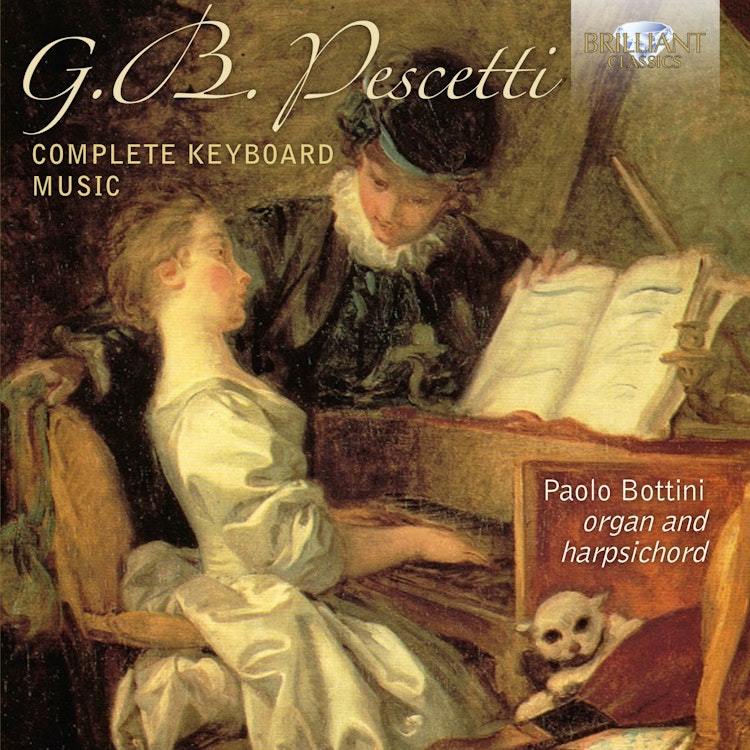
Giovanni Battista Pescetti's 1739 sonatas show a transition from the Baroque to the Galant style, featuring dance-like movements, counterpoint, and episodes of accompanied melody.
Recording & Production
This album features two historic Pietro Nacchini organs from the 1740s, located in the Basilica di S. Giorgio Maggiore and the Chiesa di S. Cassiano Martire in Venice.
Composer Biography
Giovanni Battista Pescetti worked in London from around 1734, becoming director at Covent Garden in 1737 and head of the King's Theatre the following year, where he produced several operas.
Critical Reception
The 18th-century music historian Charles Burney noted a "fragility" in Giovanni Battista Pescetti's counterpoint and considered his works pleasant but inferior to Handel's.
Interpretation
Performer Paolo Bottini chose to play Giovanni Battista Pescetti's harpsichord sonatas on the organ, believing the music's expressive melody benefits from the variety and refinement of sound offered by the historic instruments.
Composer Biography
Giovanni Battista Pescetti, the composer, was born in Venice in 1704 into a family connected to St. Mark's Basilica, where his father and grandfather were organ restorers and keepers.
Composition History
The 1739 London edition of Giovanni Battista Pescetti's Sonate per gravicembalo was dedicated to Grace Boyle, the daughter of a British statesman, possibly as a gesture to gain favor with her father, Field Marshall Richard Boyle.
You might also enjoy...
Great European Organs, Vol. 88
Couperin, F.: Organ Masses
Valeri: Complete Organ Music
Bruhns & Scheidemann: Organ Works
¡Bravo Grande!
Scheidemann: Organ Works
G. Silbermann Orgel der Petrikirche in Freiberg
Regina Renata - Die Orgel in St. Katharinen Hamburg
Kuhnau: Complete Organ Music
Hakim Plays Hakim: Grandes Orgues Aristide Cavaillé-Coll of La Trinité of Paris
Voluntaries & Interludes
The Great Organs of First Church, Vol. 1
Saxer, Duben, Schiefferdecker: Complete Organ Works