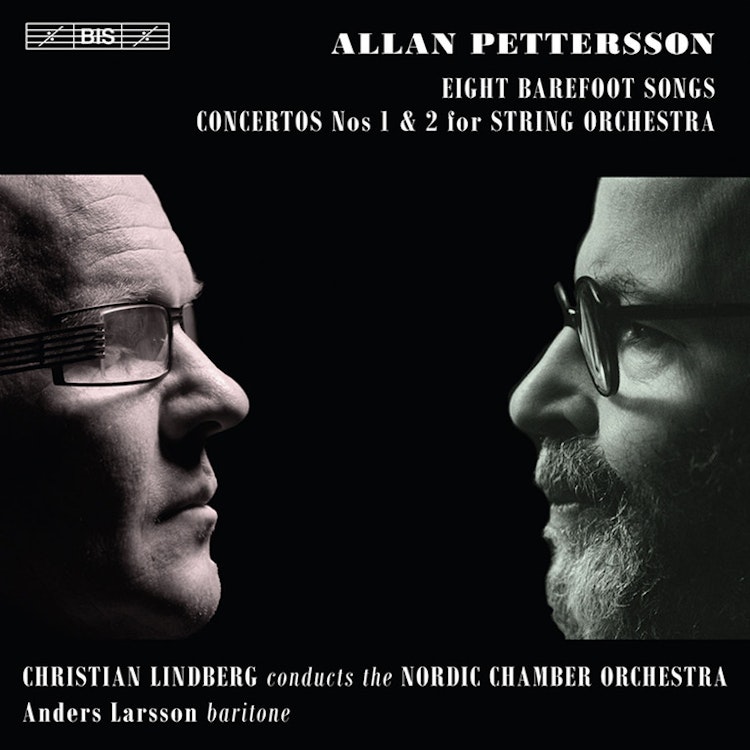
Pettersson's Concerto No. 1 for String Orchestra (1949-50) reflects his preoccupation with Béla Bartók's music, particularly the slow movement of Bartók's Divertimento for string orchestra.
Composer Biography
Allan Pettersson's "Eight Barefoot Songs" reflect his difficult childhood and youth, marked by poverty, social exclusion, his mother's strict religious attitudes, and his father's alcoholism.
Compositional Technique
Pettersson's "Eight Barefoot Songs" are musically rooted in the Swedish 'romans' tradition and sometimes allude to historical models like Schubert's "Winterreise."
Composition History
The melodies from Pettersson's "Barefoot Songs" were occasionally quoted in his larger-scale compositions, such as the Sixth and Fourteenth Symphonies, and even served as the nucleus for his Violin Concerto No. 2.
Composer's Artistic Vision
For his Concerto No. 1 for String Orchestra, Pettersson prioritized expression, urgency, and wild, alternating rhythms over precise intonation, stating, "So do not reduce the tempo in order to get the details pedantically correct."
Critical Reception
The premiere of Pettersson's Concerto No. 1 for String Orchestra in 1952 received sharply contrasting reviews, with one critic suggesting he stop composing, while another praised his unique aesthetic.
Composition History
Antal Doráti, principal conductor of the Stockholm Philharmonic Orchestra (1966-74), orchestrated eight of Pettersson's "Barefoot Songs" into a suite, transforming them into full-scale orchestral songs.
You might also enjoy...
Shostakovich: Chamber Symphony Op. 110a
Bartók: Divertimento - Britten: Variations on a Theme of Frank Bridge
Schönberg, Veress, Bartók: Verklärte Nacht
Bartok, B.: For Children / Divertimento / Romanian Folk Dances