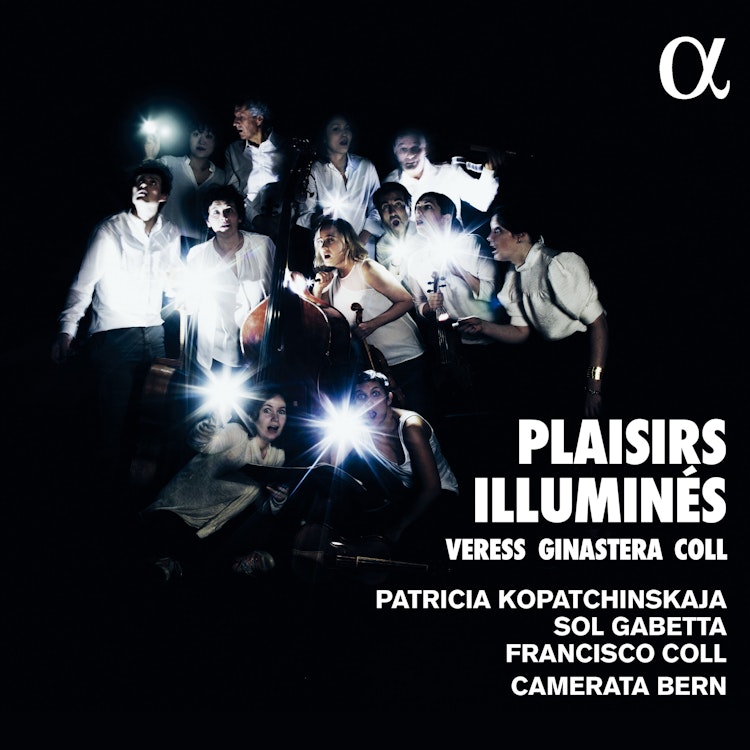
Alberto Ginastera's (1916-1983) Concerto per corde (Concerto for strings, 1966) experiments with quartertones, found in the music of original Native American inhabitants, and uses twelve-note technique for the first time in its 'Scherzo fantastico'.
Composer's Artistic Vision
Francisco Coll's (b. 1985) Double Concerto for violin, cello and chamber orchestra, titled Les plaisirs illuminés, is inspired by Salvador Dalí and the Surrealists' motto: 'Create impossible worlds in a very realistic way'.
Composer's Artistic Vision
The composers on this album are linked by their relationship to Bartók and his folkloristic reimagining of music, and by their direct approach to the sensual and physical qualities of instruments and material.
Recording & Production
The album was recorded in June 2019 at Radio Studio Zürich, Schweizer Radio und Fernsehen SRF, with Peter Laenger (Tritonus) as recording producer, editor, and mastering engineer.
Composer Biography
Sándor Veress (1907-1992), a Hungarian composer, documented folk music in Hungary and Romania using a phonograph, similar to his teachers Bartók and Kodály.
Composer's Artistic Vision
Sándor Veress (1907-1992) enjoyed writing difficult music, stating that he loved to write in a difficult way, 'so that the performers would have to sort the thing out for themselves'.
Composition History
Sándor Veress's Musica concertante per 12 archi was written in 1965-66 for the newly founded Camerata Bern, the chamber orchestra featured on this album.
You might also enjoy...
My Tribute To Yehudi Menuhin
Take Two
For Seasons
Trumpet Consort
Exclusive: Verbier Festival Academy 2021 – Soloists III