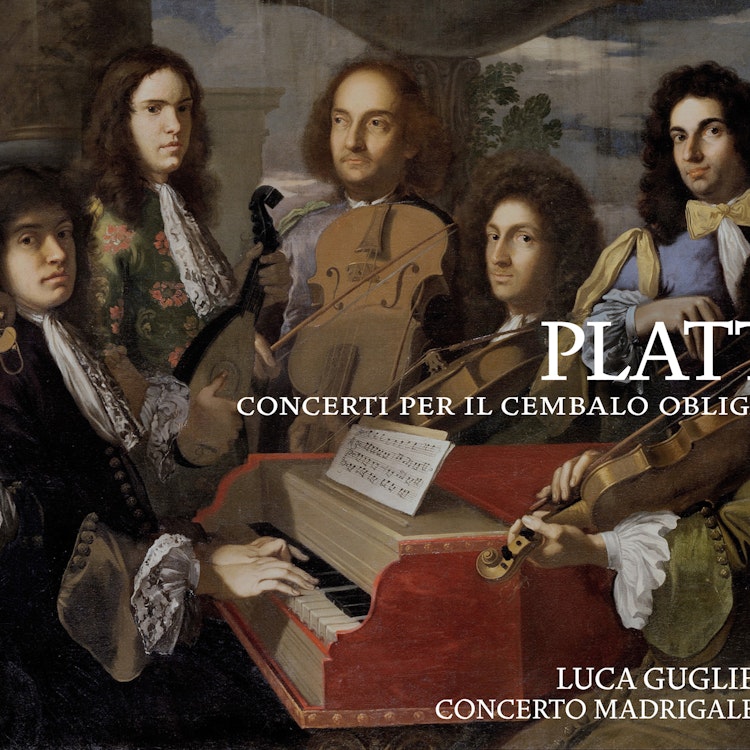
The fortepiano used for this recording is an exact copy of a 1726 instrument by Bartolomeo Cristofori, one of the earliest pianos in history, featuring a four-octave range (C to c''').
Historical Context
A portrait of Platti as a violone-player is believed to be included in Giovanni Battista Tiepolo's allegorical fresco of Europe on the ceiling of the Würzburg Residenz staircase.
Composer Biography
Platti, while in Siena, encountered the 'cembalo a martelletti', an early fortepiano invented by Bartolomeo Cristofori, thanks to Violante Beatrice di Baviera, widow of Grand Prince Ferdinand.
Composer Biography
Platti was a versatile musician who played violin, violoncello, oboe, harpsichord, organ, and fortepiano, and composed for all these instruments.
Compositional Technique
Platti's keyboard sonatas are considered 'modern' for their three-part, bithematic structure, melodic invention, unexpected rhythms, and bold modulations, anticipating the pre-romantic 'Sturm und Drang' movement.
Composer Biography
Giovanni Benedetto Platti's exact birth date of July 9, 1697, was confirmed by a letter from Domenico Palafuti, a 'virtuoso player of the Theorbo, Organ, Harpsichord and many other instruments'.
Composer's Artistic Vision
Platti's ability to combine his Italian education with the compositional arts learned in Germany resulted in an original, balanced, and 'prophetic' style that anticipated musical trends by forty years.
You might also enjoy...
William Lawes: Consort Sets In Five & Six Parts
Befiehl du deine Wege Variation (After Matthäuspassion, BWV 244, No. 53: Befiehl du deine Wege) [Arr. for Violin & String Quintet by Tim Allhoff]