After Stalin's death, a new music festival, the Warsaw Autumn in 1956, showcased Poland's musical potential to the world, combining national traditions with Western modernism.
Historical Context
Poland's political history, marked by foreign domination and disappearance from the map for centuries, hindered the development of a continuous cultural identity.
Composition History
Szymanowski's Six Kurpian Songs, written in 1928-29 and premiered in 1931, draw on the distinct folk culture of Kurpie, a thinly settled region in northeast Poland.
Performer Biography
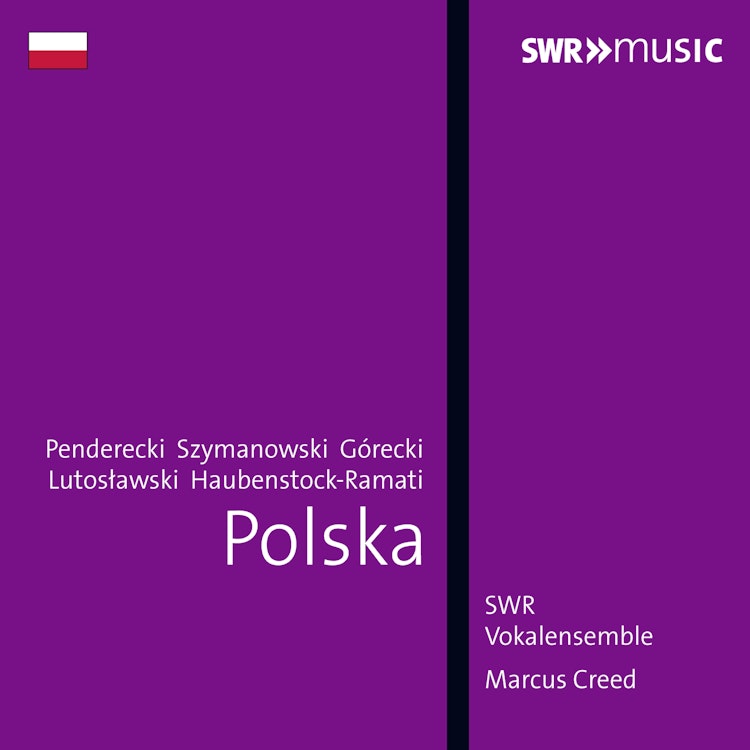
Marcus Creed, the artistic director of the SWR Vokalensemble, studied at King's College Cambridge, Christ Church Oxford, and the Guildhall School in London.
Composer Biography
Krzystof Penderecki, Poland's most famous living composer, initially led the avant-garde with cluster compositions around 1960, but later returned to a more tonal, neoromantic style.
Composer's Artistic Vision
Penderecki's deep roots in Catholicism led him to turn to sacred music in the 1960s, composing persistently with a confessional bent.
Composer Biography
Karol Szymanowski, considered the father of modern Polish music, sought to create a national musical idiom that avoided both imitating Chopin and simple folklorism.
You might also enjoy...
Choral Concert: Cologne Kantorei - Schroeter, L. / Sweelinck, J.P. / Brahms, J. / Bruch, M. / Reger, M. (Motets for Christmas)
Scandinavian Choir Music
Brahms: Complete Choral Works
Schoenberg: Choral Music
Half Monk, Half Rascal
Ôm
A Very English Christmas
Es ist ein Ros entsprungen - Weihnachtliche Chormusik
Now the Green Blade Riseth: Choral Music for Easter