Poulenc adhered strictly to tonality, emphasizing melodic elements, refined simplicity, and clarity in his music, believing there was room for new music using existing chords.
Composition History
Poulenc's Suite française, originally an orchestral work from 1935, was revised for cello and piano in 1953 and premiered by the composer and cellist Pierre Fournier, whom Poulenc called his 'ange celliste'.
Compositional Technique
In Le travail du peintre, Poulenc aimed to 'portray' painters like Braque, Gris, Picasso, Chagall, Klee, Miro, and Villon musically, treating the voice and piano accompaniment as absolutely equal partners.
Compositional Technique
Francis Poulenc, like Alexander Scriabin, used the 'Prometheus Chord' or 'Mystical Chord' in moments of great emotional tension, such as in the song cycle Le travail du peintre, to illustrate moods like Night, Love, Life, or Farewell.
Composer Biography
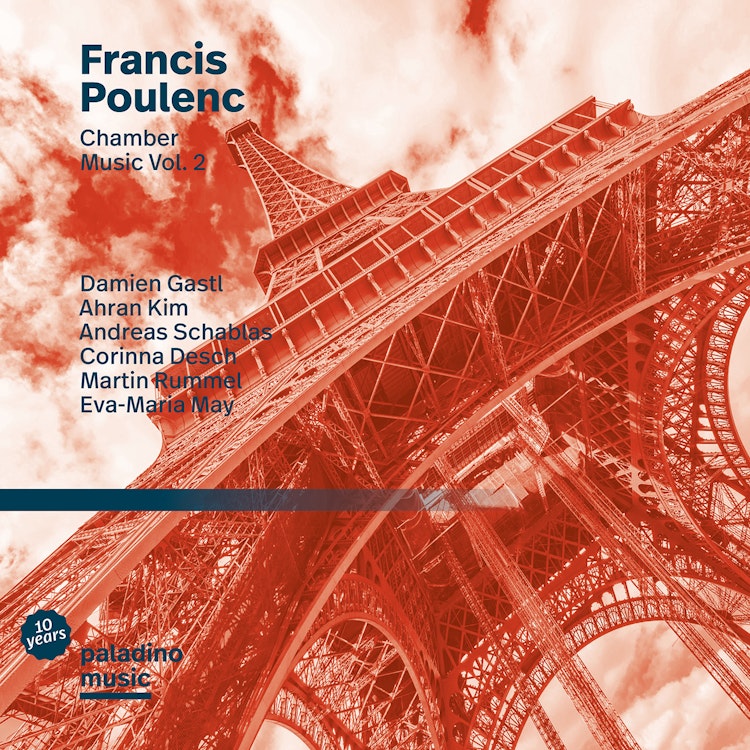
Francis Poulenc (1899-1963) was a versatile French composer, belonging to the group 'Les Six', whose style is difficult to categorize.
Composition History
The song cycle Le travail du peintre (The Painter's Work) was inspired by a lively correspondence between Poulenc and poet Paul Éluard, who had published poems about contemporary painters in 1948.
You might also enjoy...
G. Baxter: Ask of Me What the Birds Sang
Legacy: Lutosławski, Świder, Lasoń
Music for Cello
Whisper Me a Tree
Music for a Prince, Music by a Prince
A Time of Vision and Eternity: Songs & Chamber Music
Victorian Cello Sonatas
Music Of Latin America performed by pianist Hilde Somer and others.
Chamber Music - Grieg, E. / Hindemith, P. / Poulenc, F. / Martinů, B. (The Beauty of Two) (Kennedy Center Chamber Players)
Shostakovich & Prokofiev: Cello Sonatas
Cello Arrangements - Piazzolla, A. / Villoldo, A.G. / Gardel, C. / Salgan, H. / Gade, J.