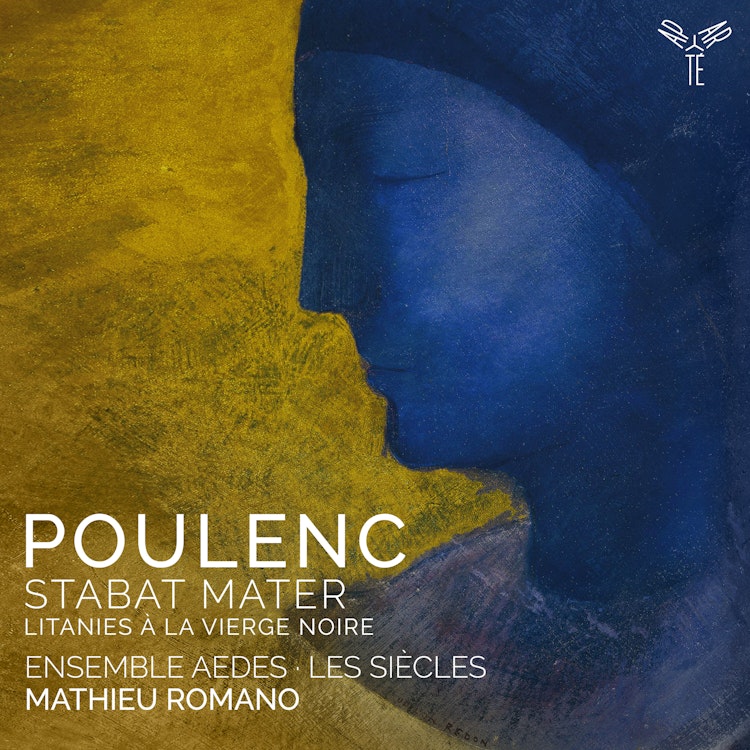
Poulenc's Litanies à la Vierge noire and Stabat mater were both dedicated to the Black Virgin of Rocamadour, a medieval pilgrimage site in France.
Composition History
Poulenc began composing his Litanies à la Vierge noire in just seven days in August 1936, after visiting the shrine of the Black Virgin at Rocamadour following the tragic death of a fellow composer, Pierre-Octave Ferroud.
Recording & Production
This recording features Les Siècles, an orchestra that performs on period instruments from the first half of the 20th century, relevant to the era of Francis Poulenc's compositions.
Compositional Technique
Poulenc described his Stabat mater as a 'requiem without despair', blending dramatic and contemplative elements with a certain violence but no sentimentality.
Composer Biography
Francis Poulenc, a largely self-taught composer, became one of the most important 20th-century exponents of sacred music, despite having been known as the 'bad boy' of French music.
Composition History
Poulenc composed his Stabat mater as an 'intercessional prayer' for his friend Christian Bérard, a painter and designer, who died suddenly in 1949.
Composition History
The Litanies à la Vierge noire was Poulenc's first specifically religious work, while the Stabat mater was his first choral work with orchestra.
You might also enjoy...
Lux Aeterna
Iste Confessor - The Sacred Music of Domenico Scarlatti
Now May We Singen: Music for Advent and Christmas
The Sacred Spirit of Russia
The Sacred Spirit of Russia
Berlioz: Requiem; Five Sacred Pieces
A Festival of Psalms
Copland - Thomson: Sacred & Secular Choral Music
Te Deum & Jubilate, Vol. 3
A Winter's Light: A Christmas Collection
Voces Sacrae: Even Such is Time (Recent British Choral Music)