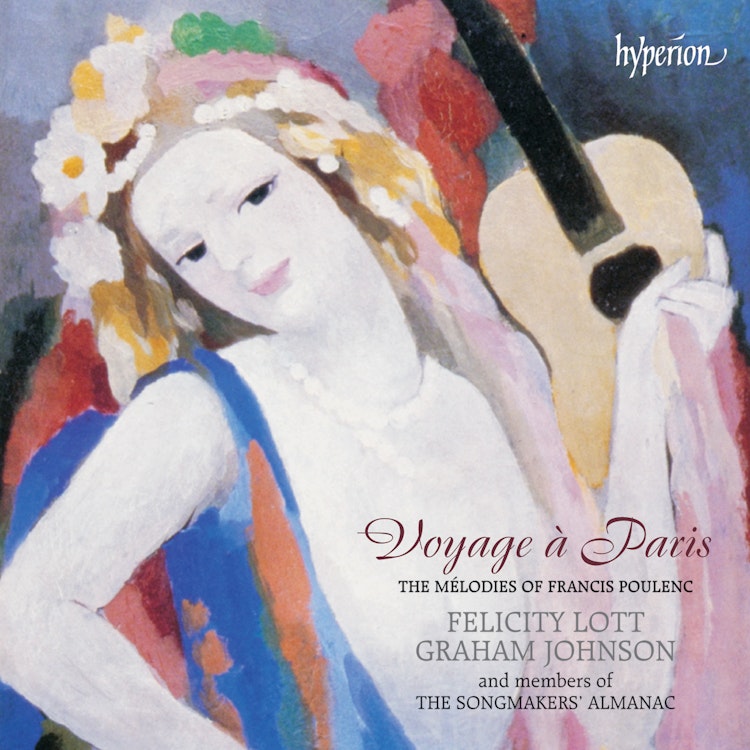
Poulenc: Voyage à Paris (Hyperion French Song Edition)
3/29/2024, 30 Tracks, 1:05:47
Featuring
Dame Felicity Lott
Graham Johnson
Anthony Rolfe Johnson
Richard Jackson
Ann Murray
Francis Poulenc
Did you know?
1/7
Composition History
The song "À sa guitare" by Poulenc, featuring text by Pierre de Ronsard, was originally written for a play about Marguerite de Valois and first sung by Yvonne Printemps.
Compositional Technique
Poulenc's Métamorphoses, based on texts by Louise de Vilmorin, showcases his three basic song styles: fast and capriciously lyrical, slow and touchingly lyrical, and fast café-concert virtuosity.
Album & Artwork
The cover of this booklet features a painting titled "La Guitare" by Marie Laurencin, a painter who also collaborated with Apollinaire and designed for Poulenc's ballet Les Biches.
Composer's Artistic Vision
Poulenc considered being known as "the musician of Apollinaire and Éluard" his finest title to fame, highlighting the profound influence these poets had on his work.
Composition History
The song "Priez pour paix" was written during the tense period of the Munich crisis, using words by Charles, duc d'Orléans, a 15th-century poet.
Cultural Impact
Poulenc's "Les chemins de l'amour" is a popular waltz often used as an encore, demonstrating his ability to write popular 'hits' similar to film music.
Composer Biography
In 1936, a pivotal year for Poulenc, he reconverted to Catholicism after a mystical experience and began a significant collaboration with poet Paul Éluard.
You might also enjoy...
Prima Verba
Green - Mélodies françaises
The Complete Songs of Poulenc, Vol. 2
Victor Hugo – Poésie chantée d’un visionnaire
Chabrier, E.: Vocal Music
Soirée française
Soirée française
Poulenc: Les anges musiciens - Mélodies
Les chemins de l'amour - Songs By Duparc, Ravel, Poulenc & Satie