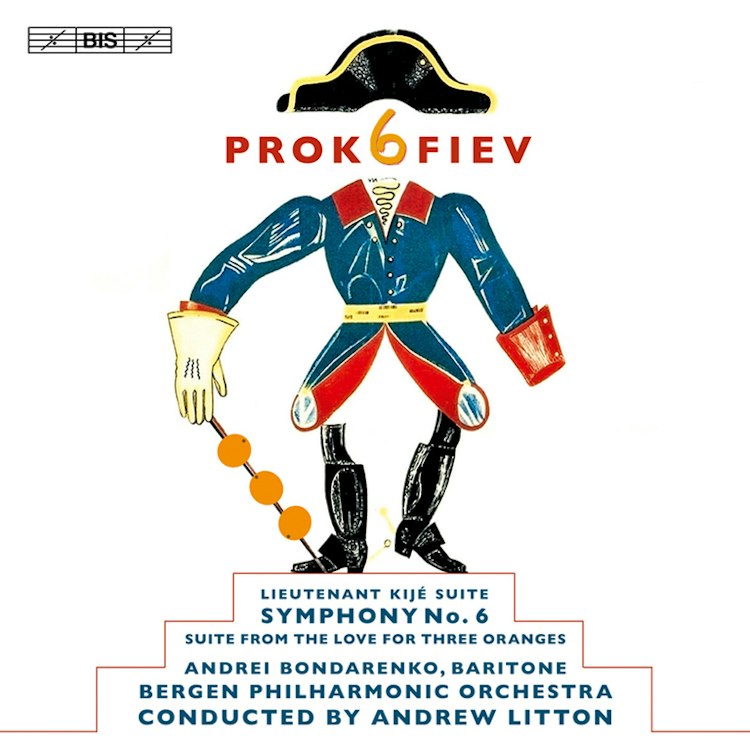
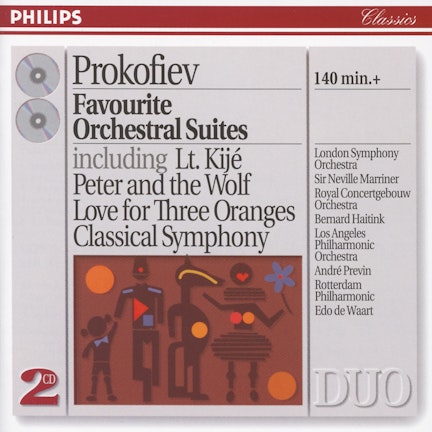
Prokofiev: Symphony No. 6 - Lieutenant Kije Suite - The Love for Three Oranges Suite
3/26/2013, 14 Tracks, 1:19:09
Featuring
Andrew Litton
Andrei Bondarenko
Bergen Filharmoniske Orkester
Sergei Prokofiev
Did you know?
1/7
Composition History
Prokofiev composed the score for Lieutenant Kijé, one of the earliest Soviet sound films, in 1932, finding the story of a non-existent officer irresistible.
Composer Biography
Sergei Prokofiev, after returning to Russia in the mid-1930s, aimed to be recognized as the Soviet Union's leading composer alongside the younger Shostakovich.
Performer Biography
The Bergen Philharmonic Orchestra, featured on this recording, was founded in 1765, making it one of the world's oldest orchestras, and Edvard Grieg was its artistic director from 1880-82.
Composition History
Prokofiev's opera The Love for Three Oranges, premiered in Chicago in 1921, was inspired by avant-garde director Meyerhold's theatrical innovations and aimed to be the 'opera of the future'.
Composition History
Prokofiev's Sixth Symphony was composed during a period of declining health for the composer, who suffered from constant headaches and was advised by doctors to avoid all excitement, including composition.
Composer's Artistic Vision
Prokofiev stated that despite the victory of the war, everyone carried 'wounds that cannot be healed', influencing the atmosphere of uncertainty in his Sixth Symphony.
Critical Reception
Prokofiev's Sixth Symphony was initially a success, but after the 1948 Party resolution, it was singled out as 'abnormal', 'repellent', and 'pathological', leading to it not being performed in Russia for many years.
You might also enjoy...
Prokofiev: On the Dnieper, Semyon Kotko Suite & Lieutenant Kijé Suite
Prokofiev: Lieutenant Kijé Suite, Love for Three Oranges Suite, Overture in B-Flat
Prokofiev: Chout Suite (The) / The Steel Dance Suite / The Love of 3 Oranges Suite
Prokofiev, S.: War and Peace Symphonic Suite / Summer Night / Russian Overture
Prokofiev: War and Peace Symphonic Suite / Summer Night Suite
Prokofiev: Symphony No.5/The Love for 3 Oranges Suite/Scythian Suite