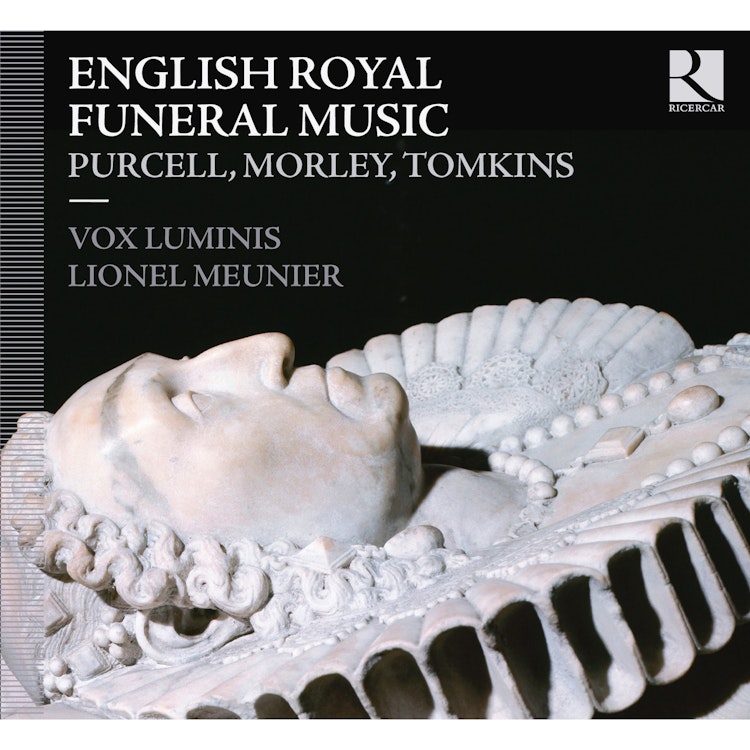
Purcell, Morley & Tomkins: English Royal Funeral Music
2/26/2013, 16 Tracks, 1:02:29
Featuring
Lionel Meunier
Benoît Laurent
Jean-François Madeuf
Guy Penson
Vox Luminis
Lingua Franca
Les Trompettes des Plaisirs
Henry Purcell
James Paisible
Thomas Tollett
Thomas Morley
Thomas Weelkes
Thomas Tomkins
Did you know?
1/7
Composition History
For Queen Mary's funeral, Henry Purcell, the court composer, had to compose a replacement for Thomas Morley's 'Thou knowest, Lord' after the original score went missing.
Historical Context
Thomas Tomkins, a pupil of William Byrd, was one of the last musicians to serve the monarchy before King Charles I's execution in 1649, a period that was difficult for musicians under Cromwell's government.
Compositional Technique
Purcell's replacement for 'Thou knowest, Lord' used four 'flatt' or slide trumpets to double the vocal parts, adding a stronger, more emphatic instrumental color.
Compositional Technique
Thomas Weelkes's 'Death hath deprived me', a lament for Morley, uses dissonance in a new expressive way, linking to the musical language Purcell would develop.
Instruments
The 'flatt' or slide trumpet, used in Queen Mary's funeral music, was an English invention with a slide mechanism similar to a trombone, allowing it to play a complete chromatic scale.
Historical Context
The album features music for royal funerals, including works for Queen Mary II of England, who died of smallpox in 1694 at age 32.
Composer Biography
Thomas Morley, a pupil of William Byrd and a Gentleman of the Chapel Royal, was officially responsible for composing music for that institution.
You might also enjoy...
Purcell: Anthems, Hymns; Locke: 3 Voluntaries
Purcell: Complete Sacred Music
Purcell: Harmonia Sacra
The Tempest
Purcell: Divine Hymns
Purcell: Devotional songs & Anthems
Royal Welcome Songs for King Charles II Volume II
Purcell : Musique pour les funérailles de la Reine Mary