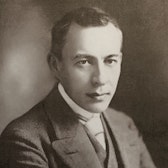
Rachmaninoff & Tubin: Works for Piano & Orchestra (Live)
2/5/2021, 4 Tracks, 1:04:31
Featuring
Mihkel Poll
Mihhail Gerts
Estonian National Symphony Orchestra
Sergei Rachmaninoff
Eduard Tubin
Did you know?
1/7
Performer Biography
Mihkel Poll, the pianist on this recording, is an Estonian musician who has performed in major venues worldwide and won numerous international piano competitions.
Composer's Artistic Vision
Rachmaninoff intended the main theme of his Piano Concerto No. 3 to be sung by the piano, drawing inspiration from his childhood milieu of Slavonic chant, Russian folksong, and romanzas.
Notable Performances
The second performance of Rachmaninoff's Piano Concerto No. 3 was conducted by Gustav Mahler, whom Rachmaninoff considered one of the best conductors of the age.
Composition History
Eduard Tubin's Concertino for piano and orchestra was his first large-scale work after settling in Sweden as an exile, written between December 1944 and February 1945 in a displaced persons camp.
Historical Context
Both Sergei Rachmaninoff and Eduard Tubin were forced to flee their homelands as refugees due to political upheaval: Rachmaninoff after the 1917 October Revolution and Tubin during the Soviet occupation of Estonia in 1944.
Compositional Technique
Rachmaninoff's Piano Concerto No. 3 is known for its melodic intensity, expressive harmonic progressions, and masterful use of latent polyphony, with virtuosity serving as an integral component of its structure.
Composition History
Rachmaninoff composed his Piano Concerto No. 3 in the summer of 1909 at his Ivanovka residence and completed it in Moscow before embarking on his first American concert tour.
You might also enjoy...
Tchaikovsky & Khachaturian: Piano Concertos
Bendix / Simonsen: Danish Piano Concertos Vol. 4
Scharwenka: Piano Concertos Nos. 2 & 3 (Hyperion Romantic Piano Concerto 33)
Rachmaninov & Khachaturian: Piano Concertos
Grieg & Rachmaninov : Piano Concertos
Rachmaninoff: Rhapsody on a theme of Paganini [1959]; Dohnányi: Variations on a Nursery Song [1959]
Dohnanyi: Piano Concertos
Rubinstein: Piano Concerto No. 4 – Scharwenka: Piano Concerto No. 1 (Hyperion Romantic Piano Concerto 38)
Ries: Piano Concertos Nos. 8 & 9 (Hyperion Romantic Piano Concerto 75)
Rachmaninov: Complete Piano Concertos
Rachmaninoff: Piano Concertos Nos. 1-4, Rhapsody on a Theme of Paganini
Rachmaninov: Piano Concertos Nos. 1-4; Rhapsody on a Theme of Paganini