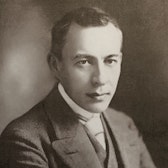
Rachmaninoff's final original work for piano ensemble, the Polka italienne for piano duet (1906), is a rare example of him letting his hair down.
Composition History
Rachmaninoff's Moments Musicaux, Op. 16, were composed in a very short time at the end of 1896 because he was in desperate need of money.
Composition History
Rachmaninoff's Preludes, Op. 23, were composed primarily out of a need to earn money, and he admitted he did not enjoy their composition.
Composition History
The Fantaisie-tableaux (Suite No.1) for two pianos was dedicated to Tchaikovsky with his permission and was inspired by the chimes of St. Sofiya's Cathedral in Novgorod.
Composer Biography
Rachmaninoff's first piece of ensemble piano music, an 1886 arrangement of Tchaikovsky's Manfred Symphony for piano duet, has not survived.
Compositional Technique
The two sets of Études-Tableaux, Opp. 33 and 39, feature Rachmaninoff's signature musical characteristics: the Dies irae motif and bell-like sonorities.
Composer's Artistic Vision
Rachmaninoff believed there must be something definite in his mind to convey a definite impression, otherwise ideas would not appear.
You might also enjoy...
Rachmaninoff: Complete Piano Music
Massenet: Piano Works
Transcriptions lyriques
Levitzki: Complete Works for Solo Piano
Albeniz / Scarlatti / Chopin / Grieg: Salon Pieces and Encores
Reminiscence
Stephen Hough's French Album
Eller: Complete Piano Music, Vol. 6
Rachmaninoff: Complete Solo Piano Music
Stanchinsky: Piano Works
Piano Recital: Stott, Kathryn - Shostakovich, D. / Ginastera, A. / Bartok, B. / Dvorak, A. / Tchaikovsky, P.I. / Sibelius, J. (Dance)