Rachmaninoff, Lutosławski & Webern: Works for Cello & Piano
8/14/2015, 8 Tracks, 50:00
Featuring
William Conway
Peter Evans
Witold Lutosławski
Anton Webern
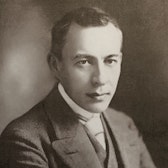
Sergei Rachmaninoff
Did you know?
1/6
Composer Biography
Sergei Rachmaninov, a composer, suffered from low self-confidence after the failures of his First Piano Concerto and First Symphony, and a disappointing meeting with his idol, Tolstoy.
Composer Biography
Anton Webern, a pupil of Arnold Schoenberg, devoted himself exclusively to atonal composition after Schoenberg abandoned tonality in 1908.
Compositional Technique
Witold Lutoslawski, a composer, incorporated aleatory (random) procedures into his music in the 1960s, treating them with restraint and rationalizing rhythmically independent counterpoints with consistent harmonic underlay.
Composition History
Rachmaninov regained his compositional confidence with the help of Dr. Nikolay Dahl, a psychiatrist specializing in hypnosis, who provided therapeutic discussions on music and arts.
Compositional Technique
Despite their brevity, Webern's Op. 11 pieces for cello and piano demand a wide range of contrasting sonorities from the cellist and nuanced dynamics and attack from the pianist.
Compositional Technique
Webern's Drei kleine Stücke for cello and piano, composed in 1914, are extremely short, with the third piece being only ten bars long, showcasing 'expressionistic brevity and intensity'.
You might also enjoy...
Depths
Noktúrna Variations
Pfitzner: Cello Sonata in F-Sharp Minor, Op. 1
Christoph Croisé: Lullabies, Op. 18 for cello and piano: 2. Lullaby for Almuth
Malinconia: Works for Cello & Piano: Sibelius & Grieg & Rachmaninov
Schubert: Nacht und Träume, Op. 43 No. 2, D. 827
Rachmaninoff & Prokofiev: Cello Sonatas
Dutch Sonatas for Violoncello and Piano Vol. 2
10 Preludes, Op. 23, No. 10: Largo in G-Flat Major (Arr. for Cello & Piano by Julian Riem)
Malinconia: Works for cello & piano: Sibelius & Grieg & Rachmaninov
Schubert: Im Abendrot, D. 799 (Version for Cello and Piano)