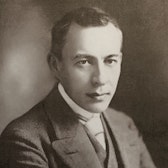
Rachmaninoff's Etudes-Tableaux Op. 39 were among the last music he composed in Russia before leaving his native land forever in December 1917, during a period of immense political upheaval.
Composition History
Rachmaninoff's Cello Sonata in G minor, Op. 19, was composed in 1901 and dedicated to his cellist friend Anatoly Brandukov, who also gave its first performance.
Compositional Technique
The Cello Sonata's main material often recalls Rachmaninoff's famous Second Piano Concerto, which was written immediately before it.
Composer's Artistic Vision
The Roman Catholic chant for the dead, Dies Irae, which haunts many of Rachmaninoff's works, seems to infuse the Etudes-Tableaux at a deep level.
Recording & Production
The Etudes-Tableaux on this album were recorded in a single complete take, a rare feat for such technically demanding pieces.
Composer Biography
Sergei Rachmaninoff composed little chamber music, and almost all of it involved the piano, his own instrument.
Composer's Artistic Vision
The title "Etude-Tableau" appears to be Rachmaninoff's own coinage, combining the idea of a technical piano study with painting a picture in music.
You might also enjoy...
Victor Yoran plays Tschaikowski, R. Schumann and Chopin
Saint-Saëns: Cello Sonata No. 1, Op. 32 & Other Pieces for Cello and Piano
Danish Cello Pieces
Rachmaninoff & Prokofiev: Cello Sonatas
Icon: Pierre Fournier
Adagio & Allegro
Aufforderung zum Tanz
Rachmaninov: Works for Cello and Piano (Complete)
Fano & Omizzolo: Works for Cello & Piano
Gliere / Gretchaninov: Works for Cello and Piano
Sviatoslav Knushevitsky, Cello
Beyond Twilight: Music for Cello & Piano by Female Composers
Cello Recital: Szabo, Ildiko - Rimsky-Korsakov, N.A. / Tchaikovsky, P.I. / Davidov, K.Y. / Saint-Saens, C. / Bartók, B. / Kodály, Z.