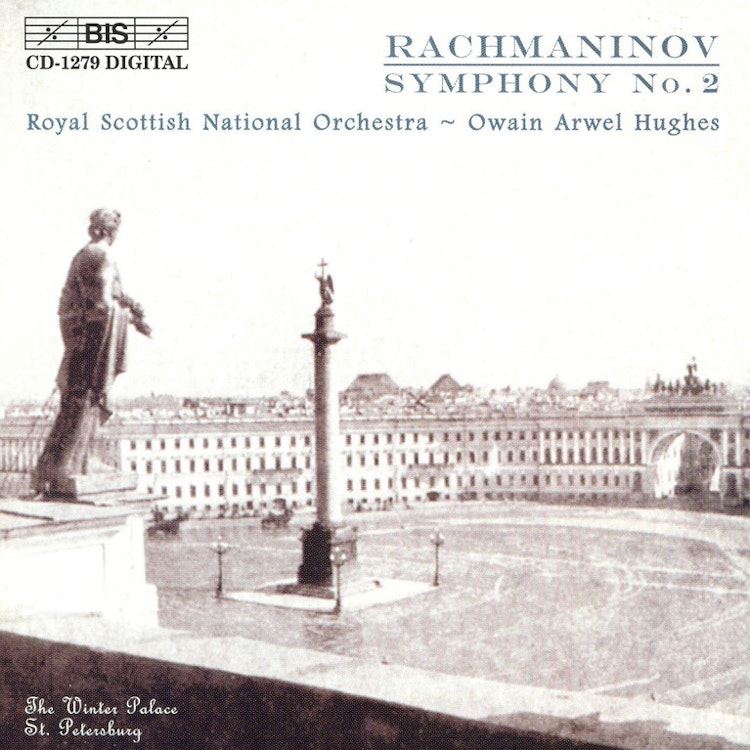
Owain Arwel Hughes, the conductor on this recording, is known for his advocacy of British composers and for founding the Welsh Proms, one of Britain's major musical festivals.
Interpretation
Despite the symphony's epic dimensions, Rachmaninov himself only crossed out two bars when asked by conductor Eugene Ormándy to make cuts for a performance with the Philadelphia Orchestra.
Compositional Technique
Like most of Rachmaninov's works, his Symphony No. 2 is predominantly in a minor key, only breaking into a jubilant major in the third movement and the finale.
Critical Reception
Unlike its predecessor, Rachmaninov's Second Symphony was a great success from its premiere, which the composer himself conducted in St. Petersburg on January 26, 1908.
Composition History
Rachmaninov's Symphony No. 2 was written in 1907, seven years after psychotherapeutic treatment restored his creative courage following the disastrous premiere of his First Symphony.
Recording & Production
The Royal Scottish National Orchestra, which performs on this recording, was founded in 1891 as the Scottish Orchestra and is supported in this project by The Royal Bank of Scotland.
Composer Biography
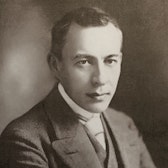
Sergei Rachmaninov, a brilliant student of the Moscow Conservatory, was 34 years old when he composed his Second Symphony, having recently completed a two-year period as conductor at the Bolshoi Theatre.
You might also enjoy...
Tchaikovsky: Symphony No. 6 in B Minor, Op. 74 "Pathétique"
Rubinstein: Symphony No. 4, 'Dramatic'
Ultimate Classics - Berlioz: Fantasy Symphony
Berlioz: Symphonie fantastique
Rachmaninoff: Symphony No. 3 in A Minor, Op. 44
Rachmaninoff: Symphony No. 2 in E Minor, Op. 27
Nielsen: Symphonies Nos. 3 & 4
Tchaikovsky: Symphony No. 6 in B Minor, Op. 74 "Pathétiqe"
Gade, N.: Symphonies Nos. 4 and 6
Rachmaninoff: Symphony No. 2 in E Minor, Op. 27
Nielsen: Symphony No. 2, Op. 16 "The Four Temperaments"