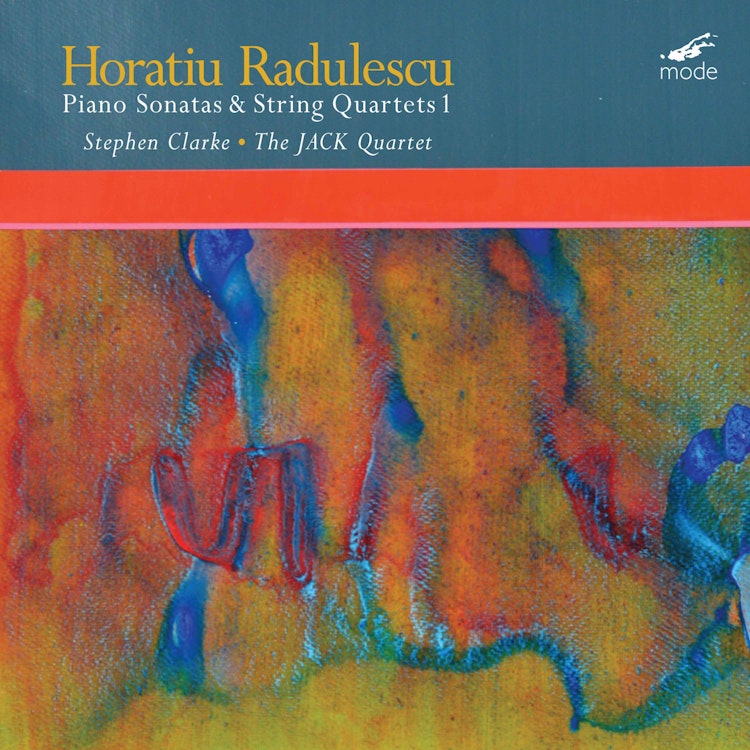
Radulescu: Piano Sonatas & String Quartets, Vol. 1
3/18/2016, 7 Tracks, 1:01:42
Featuring
Stephen Clarke
JACK Quartet
Horațiu Rădulescu
Did you know?
1/7
Compositional Technique
The Fifth String Quartet uses a 'spectral scordatura' requiring complex retuning of open strings, and its music traverses seven different harmonic spectra.
Instruments
One of Radulescu's piano reinventions, where fine, rosined threads were woven through the strings, was called the 'Sound Icon' because it resembled a religious object.
Composition History
Radulescu's second piano sonata was commissioned in 1991 by the Ministry of Arts and Sciences in Baden-Württemberg for Freiburg pianist Ortwin Stürmer, twenty-three years after his first.
Composer's Artistic Vision
The second, third, fourth, fifth, and sixth piano sonatas, as well as the fifth and sixth string quartets, are all inspired by the Tao te Ching of Chinese philosopher Lao tzu.
Compositional Technique
Radulescu 'reinvented' the grand piano in several stages, including turning it on its side and bowing its rosined strings, and retuning it spectrally.
Compositional Technique
In the Fifth String Quartet, inscriptions from the Tao te Ching determine sound production and performance techniques, with musicians shaping phrases based on the rhythm of the texts.
Composer's Artistic Vision
Horatiu Radulescu, the composer, conceived of sound as an 'endless ocean of vibrations' in his 'plasmatic music', contrasting with traditional music's discrete scale steps.
You might also enjoy...
COMPLETE RECORDINGS OF SAMUEL FEINBERG’S WORKS. Vol. 2 Piano Sonatas Nos. 4 – 8 Evgeny Starodubtsev, piano
Geoffrey Allen: Complete Piano Sonatas
Allen Sapp: Live Piano Works
Langgaard: Piano Works, Vol. 3
Nikolaï Medtner : Les trois dernières sonates pour piano
Maves, D.: Piano Sonatas Nos. 1-4
20th Century Piano Sonatas Vol. 1
Turina: Piano Music, Vol. 2
Early Piano Works of Ernst Krenek
20th Century Piano Sonatas, Vol. 7
American Classics: Piano Sonatas Vol.2
Koechlin: Works for Piano
Forsman: Piano Sonatas Nos. 1-5 / 5 Improvisations