Raff's aesthetic was distinct from his contemporaries, as he eschewed the late 19th-century obsession with operatic works derived from Wagner's Gesamtkunstwerk or Verdian melodrama.
Performer Biography
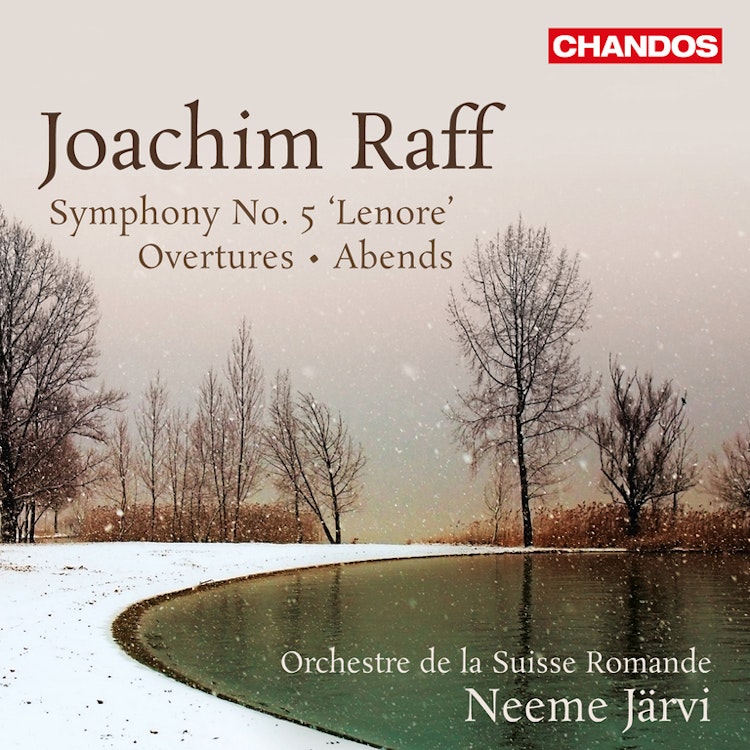
Neeme Järvi, the conductor on this album, is the head of a musical dynasty and has an impressive discography of over 450 recordings, including complete symphony cycles by Prokofiev, Sibelius, Nielsen, and Brahms.
Compositional Technique
Raff's Symphony No. 5, 'Lenore', is designed so that all four movements are effectively in one continuous tempo, creating an electrifying impact on the audience.
Recording & Production
This album was recorded using 24-bit / 96 kHz technology, which provides a dynamic range up to 48 dB greater and 256 times the resolution of standard 16-bit recordings.
Cultural Impact
The march from the third movement of Raff's Symphony No. 5, 'Lenore', even became a 'character' in Jessie Fothergill's 1877 novel, 'The First Violin'.
Compositional Technique
The orchestral Rhapsody 'Abends', Op. 163b, is unique among Raff's orchestral works because it is an orchestration of the fifth movement from his Piano Suite No. 6, Op. 163.
Composition History
Joachim Raff conceived his Symphony No. 5, 'Lenore', during the Franco-Prussian War (1870-71), basing it on Gottfried August Bürger's popular poetic ballad 'Lenore'.