Rudolf Barshai, the arranger, created orchestral versions of Ravel's and Shostakovich's string quartets to make the music accessible to a larger audience in bigger concert halls.
Composition History
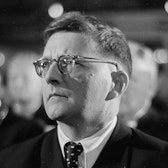
Dmitri Shostakovich, himself a master orchestrator and Rudolf Barshai's composition teacher, approved Barshai's orchestration of his String Quartet No. 8, Op. 110, allowing it to be published as 'Chamber Symphony, Op. 110a'.
Composition History
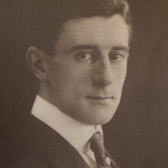
Maurice Ravel's String Quartet in F major, presented in Paris in 1905, divided audiences and caused a scandal at its premiere.
Historical Context
Dmitri Shostakovich was forced to join the communist party in 1964, a difficult period for him, despite hopes for political relaxation under Khrushchev.
Composer's Artistic Vision
Maurice Ravel, in his early string quartet, aimed to renew the classical sonata form by having themes intertwine harmoniously rather than collide.
Performer Biography
Rudolf Barshai, the arranger, founded the widely known Borodin String Quartet in his college days and later the Moscow Chamber Orchestra, which introduced Baroque, Classical, and modern chamber music to Russia.
Compositional Technique
In his String Quartet No. 10, Dmitri Shostakovich used the Baroque form of the passacaglia, a static form with repetitions of a bass theme, to characterize the 'leaden times' of the monotonous Soviet years.
You might also enjoy...
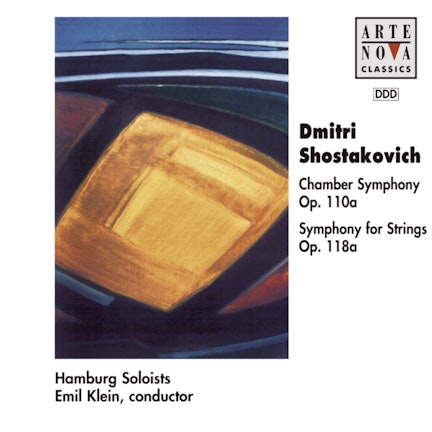
Shostakovich: Chamber Sym. Op. 110 a/Symphony For Strings Op 118 a
Shostakovich: Chamber Symphonies
Wolf-Ferrari: Sinfonia Da Camera / Strauss-Schoenberg: Kaiserwalzer / Bloch: 4 Episodes