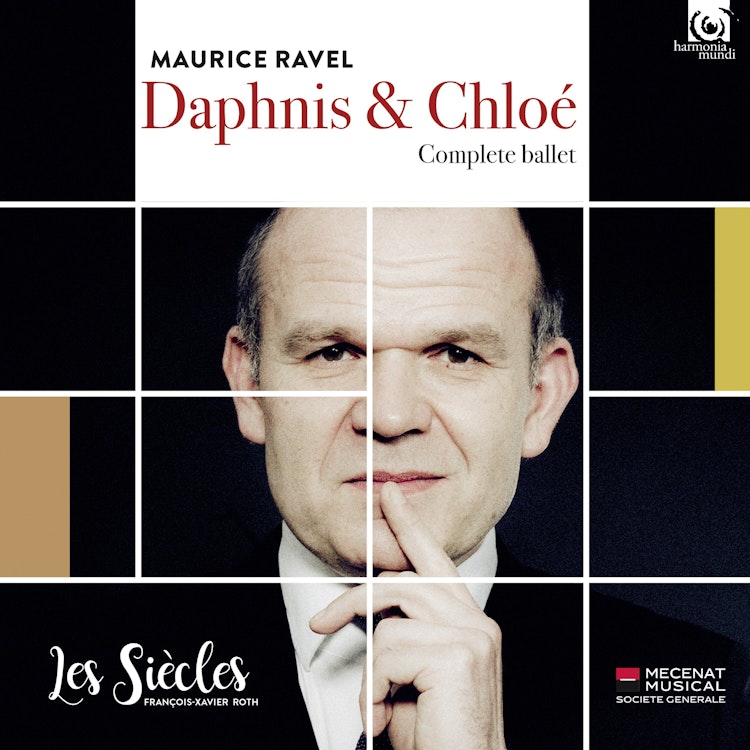
Winner of the Gramophone Classical Music Award 2018 (Orchestral)
Featuring
François-Xavier Roth
Marion Ralincourt
Les Siècles
Ensemble Aedes
Maurice Ravel
Did you know?
1/7
Composer's Artistic Vision
Ravel intended Daphnis et Chloé to be a 'vast musical fresco' faithful to 'the Greece of his dreams,' rather than an archaeologically accurate depiction.
Recording & Production
Conductor François-Xavier Roth meticulously reviewed the orchestral parts for this recording, correcting errors found in the printed score of Daphnis et Chloé.
Composition History
Maurice Ravel's ballet Daphnis et Chloé was commissioned by Serge Diaghilev for the Ballets Russes and premiered on June 8, 1912, in Paris.
Interpretation
The ensemble Les Siècles performs Daphnis et Chloé using period instruments from Ravel's time to restore the original colors and sound of the work.
Compositional Technique
Daphnis et Chloé uses the largest orchestral forces Ravel ever employed, including triple woodwind, a fourth trumpet, extensive percussion, and a mixed chorus.
Instruments
The recording uses early 20th-century French-built instruments, including gut strings, specific wind instrument bores, and period percussion, which differ significantly from modern instruments.
Critical Reception
The premiere of Daphnis et Chloé was generally well-received, though some critics found it 'Greek dressed in Russian style' and noted clichés in the choreography.
You might also enjoy...
Ravel: Piano Concertos & Alborada del Gracioso
Ravel: Daphnis et Chloé, M. 57
Ravel: Daphnis et Chloé
Ravel: Daphnis and Chloe
RAVEL, M.: Daphnis et Chloe
Ravel: Piano Concerto in G Major; Piano Concerto for the Left Hand in D Major
Ravel: The Piano Concertos by Samson François
Ma merè l'oye: Klavierkonzerte
Rapsodie espagnole; Daphnis et Chloé: Suite No. 2; Others
Ravel: Daphnis et Chloé & Rhapsodie espagnole & Alborada del gracioso