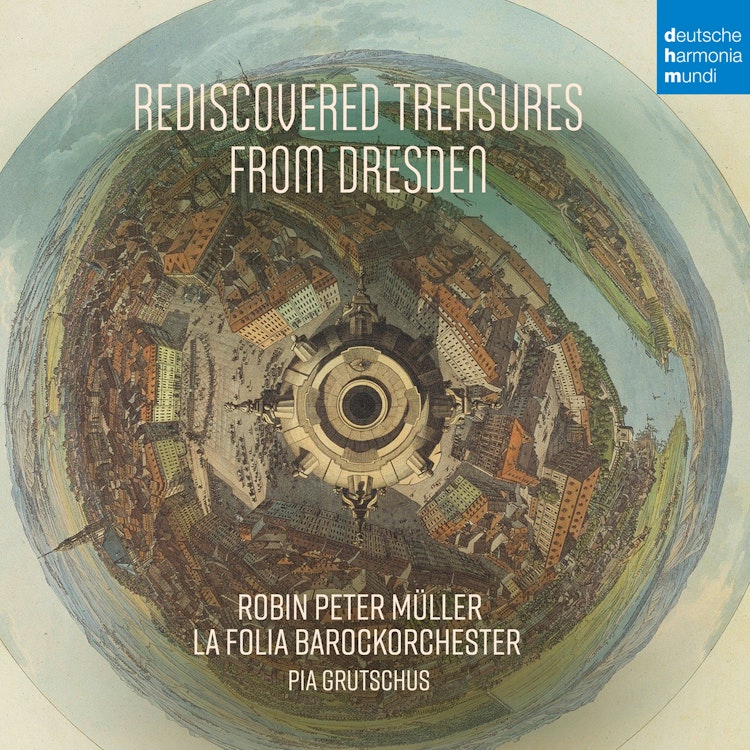
The Dresden Hofkapelle, an orchestra, rose to prominence in 1709 during the "Augustan Age" of Dresden, a period when the electors of Saxony were also kings of Poland.
Recording & Production
This album is a world premiere recording of these anonymous concertos.
Composer Biography
Johann Georg Pisendel, a leading German violin virtuoso and pupil of Giuseppe Torelli, became concertmaster of the Dresden Hofkapelle in 1728.
Recording & Production
The conductor, Robin Peter Müller, first encountered the 'Schrank II' collection, from which these anonymous concertos are drawn, at the age of 16 or 17 in the Saxon State and University Library.
Composition History
Many works in the Schrank II Collection, which reflects the Dresden Hofkapelle's repertoire, are anonymous, with their authorship still a mystery despite recent identifications.
Compositional Technique
The Concerto in F major combines Italian and French stylistic elements, typical of the "mixed taste" for which the Dresden ensemble was famous, and includes a gavotte as its third movement.
Interpretation
For the Concerto in D minor, although the solo part's character suggests a wind instrument, the performers used a solo violin, following what they believe were Pisendel's intentions.
You might also enjoy...
Torelli: Sinfonia for 3 & Concerti for 4, Op. 5
Sonatas from the Dresden Pisendel Collection
Biber: Mensa Sonora
Roma
Roma
The Four Seasons
Handel: Concerti grossi op. 6, Water Music, Fireworks Music
Telemann: Musique De Table (Tafelmusik), Vol. 3
Corelli Bolognese - Trio Sonatas by Corelli and his Successors
Caldara: Suonate da Camera a due violini con il b.c. - Opera II