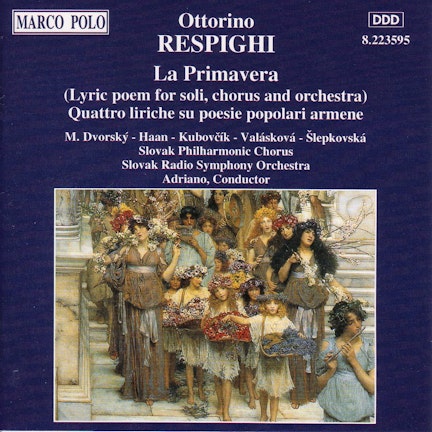
Respighi: La Primavera - Quattro Liriche - La Pentola Magica
6/16/2009, 21 Tracks, 1:19:12
Featuring
Adriano
Miroslav Dvorský
Richard Haan
Vladimír Kubovčík
Jana Tarajová-Valášková
Henrietta Lednárová
Beáta Geriová
Věra Rašková
Denisa Šlepkovská
Vladimír Havran
Michal Šintál
Gabriel Koncer
Ivan Viskup
Ivan Paulicka
František Kovács
Katarína Vavreková
Jakub Francisci
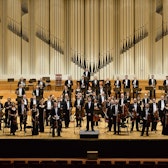
Slovak Radio Symphony Orchestra
Slovak Philharmonic Chorus
Ottorino Respighi
Did you know?
1/7
Composer Biography
Elsa Respighi, the composer's wife, was fifteen years his junior and a former pupil; she introduced him to church modes, which became an important turning point in his career.
Critical Reception
Respighi was disappointed by the cool reception of La Primavera at its 1923 premiere, believing the performers struggled with its difficulties, and his wife later complained about the lack of a proper Italian performance.
Composition History
Respighi's cantata La Primavera was completed in 1919 and was immediately followed by the symphonic poem Ballata delle gnomidi and the fairy-tale opera La bella dormente nel bosco.
Composer's Artistic Vision
La Primavera belongs to Respighi's autobiographical works, which give insight into his complex personality, torn between ascetic ideals and the sensual realities of the world.
Recording & Production
This album was recorded at the Concert Hall of Slovak Radio in Bratislava, with La pentola magica recorded in November 1991 and La Primavera and Quattro liriche in January, February, and June 1994.
Compositional Technique
The cantata La Primavera is scored for a large orchestra including double wind instruments, an additional third flute behind the orchestra, E flat and bass clarinets, four horns, three trumpets, three trombones, tuba, and a conventional string ensemble, along with extensive percussion, two harps, celesta, piano, and organ.
Composition History
The ballet La pentola magica (The Magic Pot) was one of three scores commissioned from Respighi by Dr. Aldo Molinari for the Ileana Leonidov Company, a ballet company established in Italy.
You might also enjoy...
Respighi: Primavera (La) / 4 Liriche
Respighi: Primavera (La) / 4 Liriche
Ian Krouse: Nocturnes, Op. 60 & Invocation, Op. 54
Kosa: Dirge for A Bull / Symphony No. 8 / 5 French Songs / 4 Csokonai Vitez Songs
Bussotti: The Rara Requiem
Icelandic Works for the Stage
Parisian Ballets
Stravinsky: The Firebird & Rehearsal
Leontyne Price - Hector Berlioz: Les Nuits d'été op. 7; Manuel de Falla: El amor brujo
Kent Nagano - Stravinsky
Stravinsky: Le Sacre du printemps & Perséphone
Manuel de Falla:La Vida Breve/El sombrero de tres picos etc
Manuel de Falla:La Vida Breve/El sombrero de tres picos etc