The work, subtitled a 'Mistero in three episodes', faithfully follows the medieval legend of Saint Mary of Egypt, a prostitute who converted to Christianity and spent 47 years in the desert as atonement.
Compositional Technique
Musically, "Maria Egiziaca" balances tradition with innovation, featuring dialogues, recitatives, lyrical passages, and two broad instrumental interludes that emphasize the protagonist's emotional journey.
Interpretation
Conductor Manlio Benzi describes "Maria Egiziaca" as a 'hybrid' work, difficult to categorize, lying between symphonic and operatic forms, and unique in its blend of music and iconography.
Notable Performances
The world premiere of "Maria Egiziaca" took place on March 16, 1932, at Carnegie Hall in New York, with composer Ottorino Respighi conducting.
Composition History
Ottorino Respighi's "Maria Egiziaca" (Saint Mary of Egypt) began as a concert triptych in 1931, with a libretto by Claudio Guastalla based on a medieval legend.
Compositional Technique
Respighi and librettist Claudio Guastalla conceived "Maria Egiziaca" with a 'gothic scenography' that explicitly refers to the iconographic tradition of a medieval triptych painting, with three distinct 'panels' for each episode.
Notable Performances
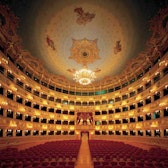
After its concert premiere in New York, "Maria Egiziaca" received its first staged performance on August 10, 1932, at the Teatro Goldoni in Venice, as part of the International Festival of Modern Music.