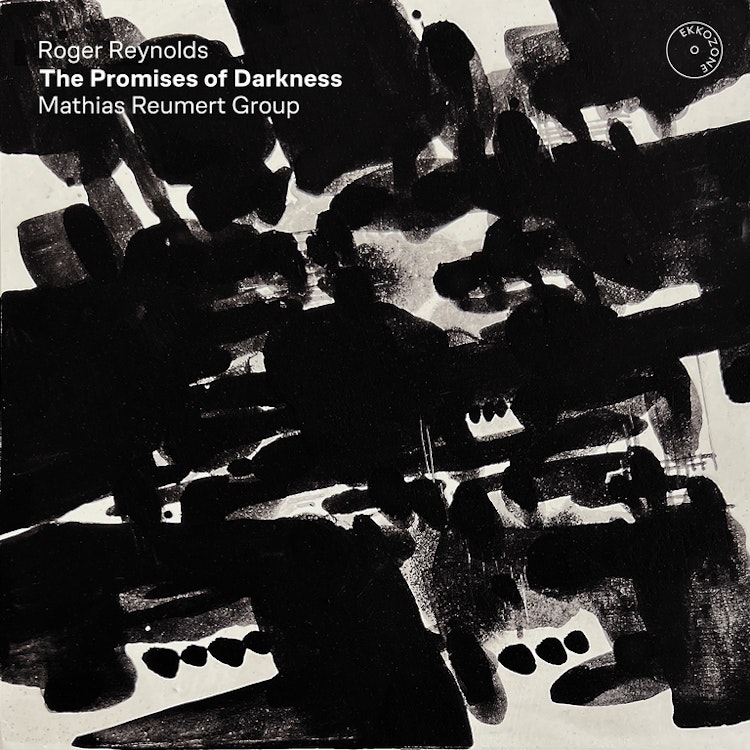
Roger Reynolds's score for 'The Promises of Darkness' combines standard musical notation and graphic notation, with some instrumental groups written one way and others the other way.
Composer's Artistic Vision
Roger Reynolds's 'Mistral' was inspired by an unexpectedly powerful and relentless wind encountered during a trip to Arles, France, which he sought to convert into a positive artistic outcome.
Composer Biography
Roger Reynolds studied briefly with Spanish-Catalan composer Roberto Gerhard, to whom the work 'The Promises of Darkness' is dedicated.
Composition History
The work 'Dionysus' was conceived from a blend of factors, including the late work of Euripides, particularly 'The Bacchae', and the exploration of chaos theory.
Recording & Production
The recording of 'Mistral' was made without direct input from composer Roger Reynolds, unlike the other pieces on the album which he rehearsed with the ensemble.
Historical Context
'The Promises of Darkness' was completed in December 1975, a year that saw the fall of Saigon and the persistence of the Cold War.
Compositional Technique
'Dionysus' uses the Hénon attractor, a non-linear system from chaos theory, to determine its formal proportions.
You might also enjoy...
Ivan Pedele: Phasing
Oriol Saladrigues Brunet: Your message could not be delivered to one or more Recipients.
Zhou: Tales From the Cave / Secluded Orchid / Heng / Valley Stream