Rhené-Baton's compositional work was deeply influenced by his discovery of Brittany, his family's land of origin, which became a continuous source of inspiration.
Composer Biography
Rhené-Baton, a key figure in Parisian musical circles in the early 1900s, was not only a pianist and composer but also a regularly engaged orchestral conductor.
Album & Artwork
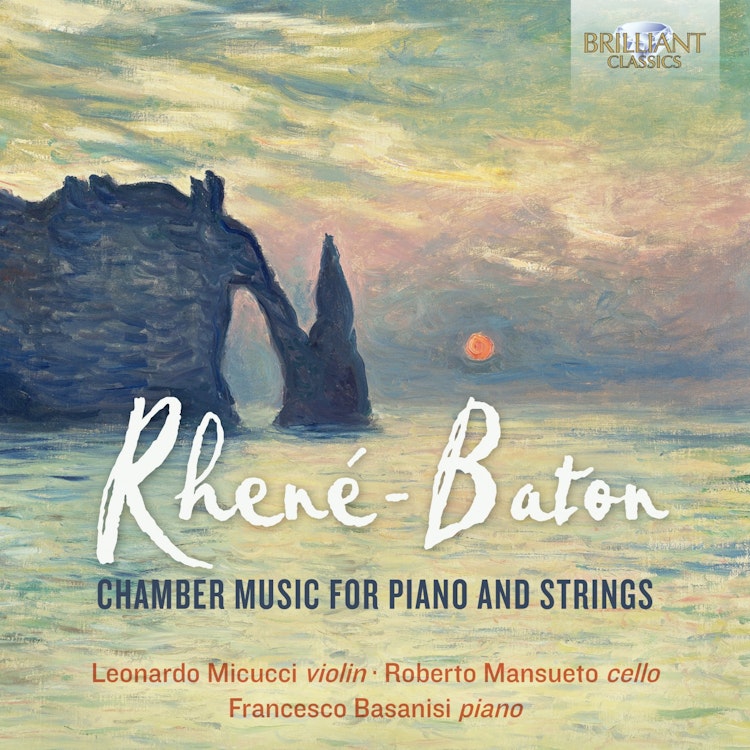
The album cover features 'Étretat: Sunset' (1883) by Claude Monet, a French Impressionist painter.
Recording & Production
This album features the first recordings of Rhené-Baton's Violin Sonata No.1 Op.24, Violin Sonata No.2 Op.46, and Suite Ancienne Op.55 for Violin and Piano.
Composer's Artistic Vision
Rhené-Baton was a co-founder of the Association des Compositeurs Bretons in 1912 and often incorporated Breton folk melodies and dialect into his compositions.
Compositional Technique
The second movement of Rhené-Baton's Piano Trio, titled 'Divertissement sur un vieil air Breton', begins with the folk melody 'Gwin ar c'hallaoued' (the wine of Gall), a well-known Breton tune.
Composition History
With the exception of the Suite Ancienne for violin and piano composed in 1933, Rhené-Baton's entire chamber music output dates from a six-year period between 1921 and 1927.
You might also enjoy...
Hungarian Heights
Mathilde Kralik von Meyerswalden: Piano Trio / Violin Sonata/ Nonet
Rabl: Chamber Music
Fuchs: Piano Trio, Violin Sonata, Viola Phantasiestücke
Winterberg: Chamber Music, Vol. 2
Winterberg: Chamber Music, Vol. 2
Copland: Chamber Music
RAVEL: Violin Sonata No. 2 in G major, Sonata for Violin and Cello in A minor, Piano Trio in A minor
Coleridge-Taylor, S.: Clarinet Quintet in F Sharp Minor / 4 African Dances / Nonet in F Minor
Isaac Stern Plays Brahms
Martha Argerich - Chamber
Mendelssohn: Works for Violin and Piano (Complete)
Flute and Piano Music By Composers of African Descent. Vol. 2
Bridge: Phantasie Piano Trio in C Minor - Martin: Piano Trio on Irish Folk Tunes - Campo: Trio, Op. 87